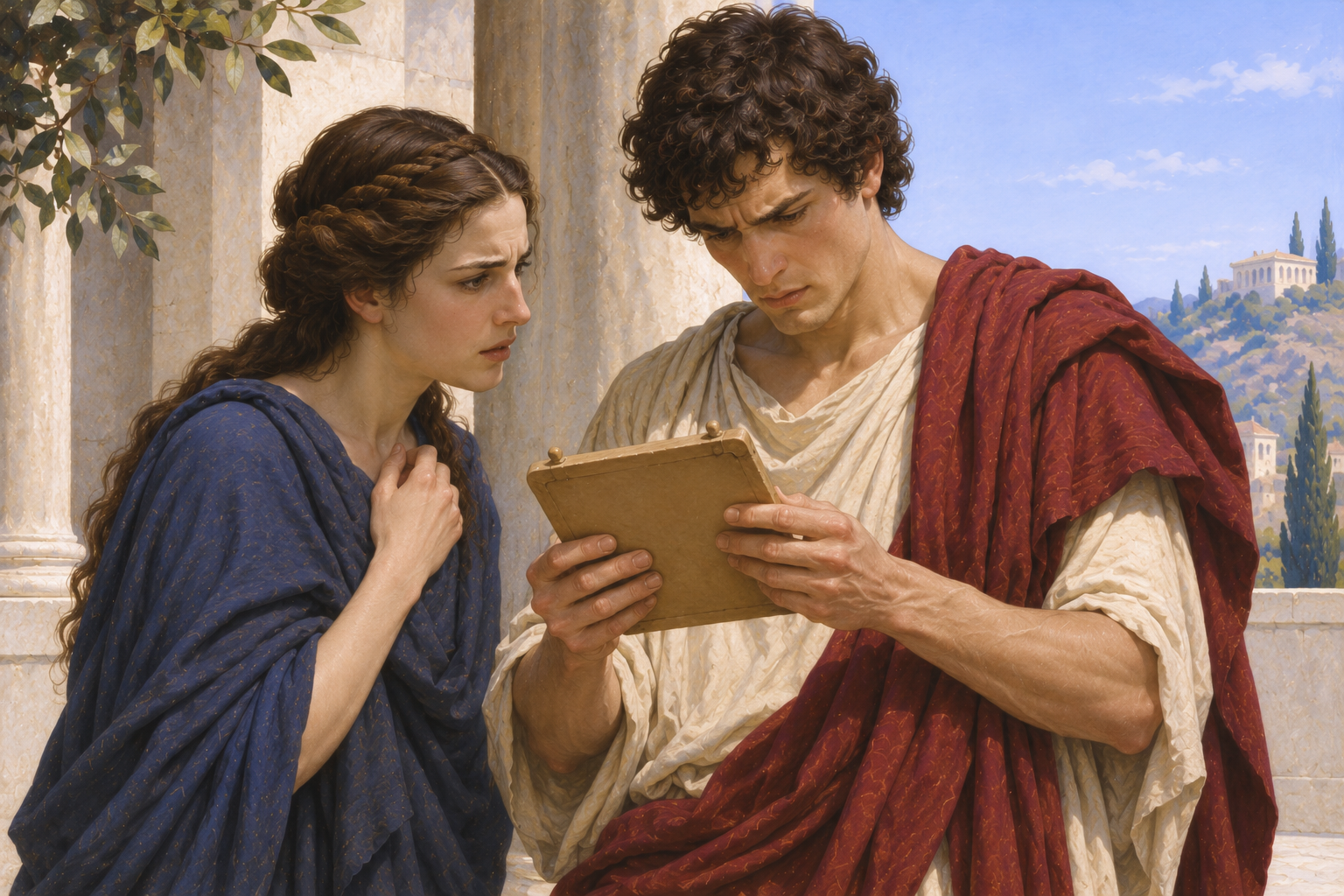
Testing Understanding: Guilt, Loyalty, and Justice in Orestes
About This Quiz
This assessment combines factual comprehension with literary and moral analysis of Euripides’ Orestes. Students examine the events following Clytaemnestra's murder, the characters' conflicting obligations, and the increasingly dangerous consequences of revenge.
Suggested use: After reading the complete play, as an individual assessment, homework assignment, or classroom review.
Part I — Reading Comprehension
Choose the best answer.
1. Who cares for Orestes during his illness at the beginning of the play?
A. Helen
B. Electra
C. Hermione
D. Clytaemnestra
2. Who condemns Orestes for killing his mother?
A. Tyndareus
B. Pylades
C. The Phrygian servant
D. Helen
3. What decision does the Argive assembly make?
A. To crown Orestes
B. To send him to Troy
C. To condemn Orestes and Electra to death
D. To exile Menelaus
4. Who remains loyal to Orestes and joins his desperate plan?
A. Creon
B. Aegeus
C. Paris
D. Pylades
5. Whom do the conspirators seize as a hostage?
A. Hermione
B. Helen
C. Electra
D. Iphigenia
6. Who describes the attack inside the palace?
A. Tyndareus
B. A Phrygian servant
C. Apollo
D. Agamemnon
7. Who intervenes at the conclusion?
A. Athena
B. Zeus
C. Apollo
D. Artemis
Part II — Short-Answer Questions
Answer each question in two to four sentences.
8. How does Orestes describe or experience his suffering after killing Clytaemnestra?
9. Why does Orestes expect Menelaus to help him, and why is that help uncertain?
10. How do Orestes and Tyndareus disagree about justice?
11. What role does Electra play in Orestes' predicament?
12. Why do the siblings and Pylades turn to a plan involving Helen and Hermione?
Part III — Literary and Moral Analysis
Support each answer with specific events or dialogue from the play.
13. Family loyalty: Explain how the play distinguishes family loyalty from moral responsibility. Use two characters.
14. Public judgment: How does the assembly report affect dramatic tension and the audience's view of public judgment?
15. Messenger narration: How does the Phrygian servant's account of the palace attack affect the tone and suspense?
16. Divine intervention: Does Apollo's final intervention resolve the play's moral conflicts? Defend your interpretation.
Classroom Extension
Choose Orestes, Electra, Pylades, Menelaus, or Tyndareus. Write a paragraph evaluating one important decision made by that character. Explain the motive, the consequences, and whether another choice was possible.
Note to the Educator
Questions 1–7 assess factual comprehension. Questions 8–12 require concise explanation. Questions 13–16 assess interpretation and the use of textual evidence.
Accept well-supported alternative interpretations, particularly concerning Orestes' responsibility and the significance of Apollo's intervention.
Reading the Play
A printable student quiz and separate teacher answer key are available by email.