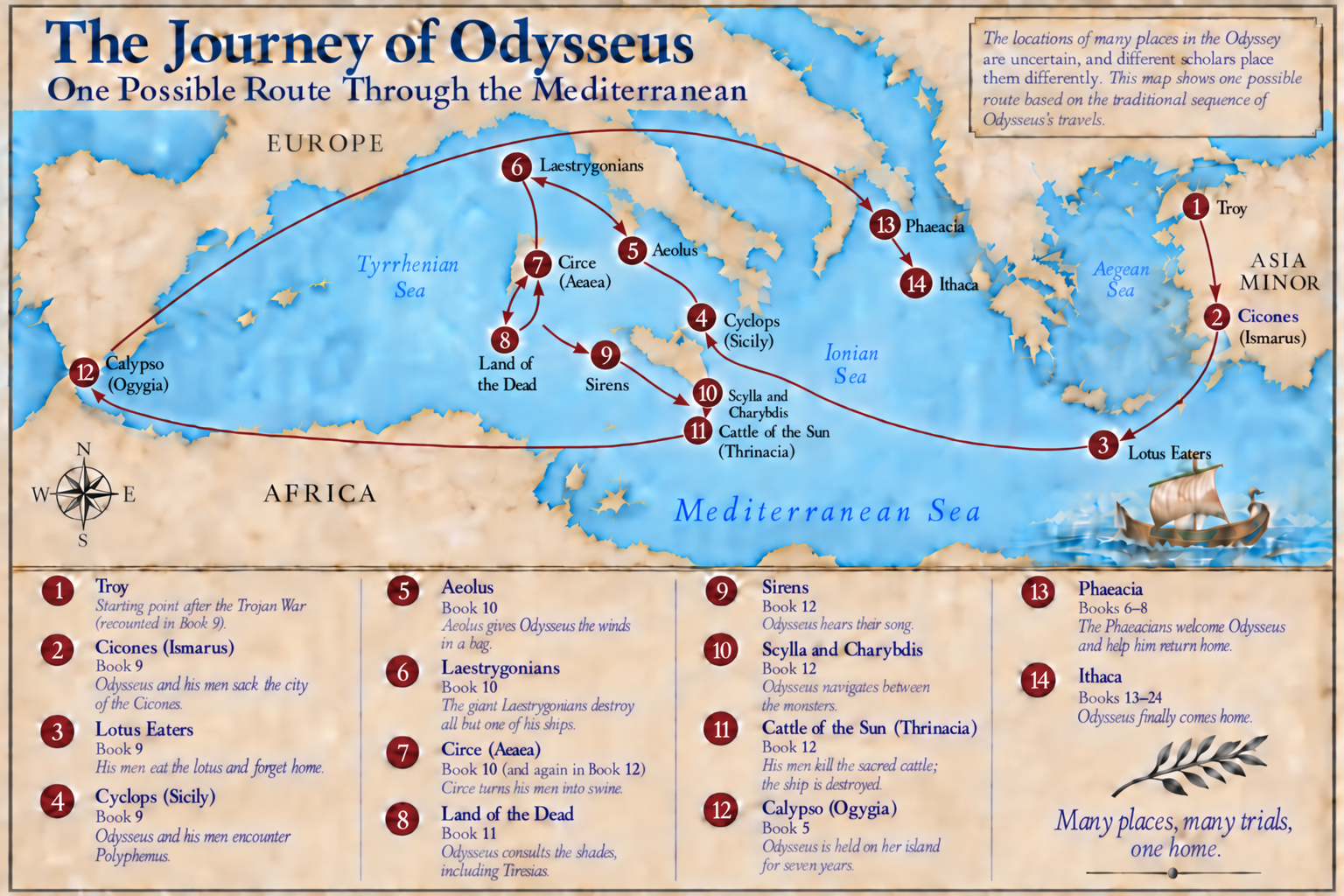
Odysseus’s journey in Homer’s Odyssey has inspired centuries of geographic debate. Homer does not provide a route that can be mapped with certainty, and scholars have proposed different locations for several of the places he visits. This classroom map presents one possible Mediterranean route while preserving the traditional sequence of Odysseus’s travels.
Route at a Glance
Troy → Cicones (Ismarus) → Lotus Eaters → Cyclops (Sicily) → Aeolus → Laestrygonians → Circe (Aeaea) → Land of the Dead → back to Circe → Sirens → Scylla and Charybdis → Cattle of the Sun (Thrinacia) → Calypso (Ogygia) → Phaeacia → Ithaca
Because Odysseus returns to Circe after visiting the Land of the Dead, Circe is revisited without receiving a second numbered stop. The map is intended as a classroom guide, not as a claim that the poem’s mythical locations can be identified with certainty.
Classroom Use
Use the map as a visual reference during reading, alongside The Odyssey Student Worksheet Pack, or for review before quizzes, discussion, and writing. Students can use it to place individual episodes within the larger homecoming narrative and to consider how geography, distance, temptation, and delay shape Odysseus’s journey.
Free Printable PDF
Teachers may download a free, print-ready PDF of this map for classroom use. The printable version includes the complete numbered route, legend, book references, and note about the uncertainty of Homeric geography.