The Myths Behind the Siege of Thebes
Seven Against Thebes belongs to a larger cycle of Greek myths concerning the royal family of Thebes. Its central conflict between Eteocles and Polynices is rooted in events that began generations before the brothers' fatal encounter. Understanding this background helps students recognize the importance of inherited curses, competing claims to authority, and the relationship between family conflict and civic destruction.
Cadmus and the Founding of Thebes
According to Greek tradition, Cadmus founded Thebes after following divine guidance to the site where the city would be established. One famous version of the myth describes his defeat of a dragon and the sowing of its teeth into the earth.
Armed warriors sprang from the ground, fought among themselves, and left a small number of survivors who became associated with the city's earliest inhabitants.
This foundation story connects Thebes with warfare and internal violence long before the conflict between Eteocles and Polynices.
Laius and the Troubled Royal House
Laius, a descendant of Cadmus, became king of Thebes. A prophecy warned that a son born to him would bring about his death.
Despite efforts to prevent this outcome, his son Oedipus survived and eventually killed Laius without knowing his identity.
The story establishes a recurring concern in Theban mythology: attempts to escape a predicted future may contribute to its fulfillment.
Oedipus and His Children
Oedipus later became ruler of Thebes and married Jocasta, unaware that she was his mother. When the truth emerged, the royal household was devastated.
Eteocles and Polynices were among the children associated with this troubled family history. Their conflict became another stage in the destructive consequences surrounding the house of Oedipus.
Ancient accounts differ in important details, including the circumstances of the brothers' inheritance and their father's curse.
The Rivalry Between Eteocles and Polynices
In a familiar version of the myth, the brothers agree to alternate their rule of Thebes. When Eteocles refuses to surrender power, Polynices seeks military support to recover his position.
The background to the dispute varies among ancient sources, but the essential conflict concerns rival claims to authority and the decision to settle a family quarrel through warfare.
In Seven Against Thebes, Eteocles defends the city while Polynices leads the attacking army.
The Seven Champions Against Thebes
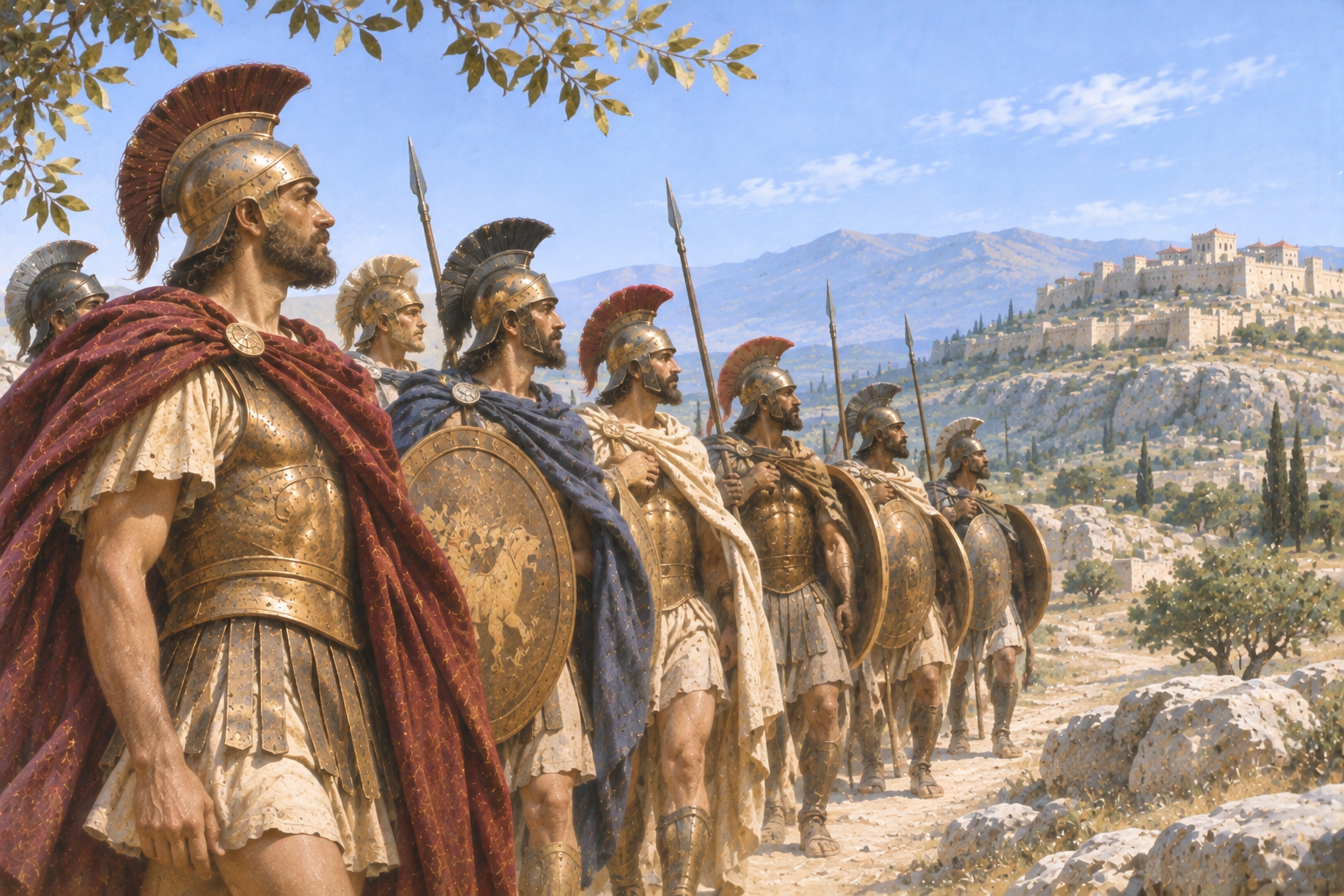
Polynices gathers allies for an expedition against his native city. Seven champions are associated with the assault upon the seven gates.
Their names and individual stories belong to a wider mythological tradition, but Aeschylus makes their shields, threats, and assigned positions central to the dramatic action.
Amphiaraus is particularly important because he understands the expedition's dangers and recognizes the moral problems surrounding the attack.
The Curse and the Brothers' Fate
The curse pronounced by Oedipus upon his sons forms a crucial part of the tragedy's background.
Their decision to confront one another appears to fulfill the destructive destiny associated with their family. Yet the play also gives particular attention to Eteocles' determination to fight Polynices.
Students should consider how inherited fate and individual choice operate together rather than assuming that one entirely eliminates the other.
Antigone and the Aftermath
In the wider Theban tradition, the brothers' deaths lead to a dispute over the burial of Polynices. Their sister Antigone becomes associated with resistance to a prohibition against honoring him.
This story is especially familiar from Sophocles' Antigone. The surviving text of Seven Against Thebes also includes related material, although scholars have questioned the authenticity of portions of its concluding scene.
The distinction between the broader myth and the surviving play is important when comparing ancient treatments of the same family.
Questions for Discussion
- How does the myth of Cadmus establish a background of conflict for the city of Thebes?
- What role do prophecies play in the stories of Laius and Oedipus?
- How does the rivalry between Eteocles and Polynices transform a family dispute into a public crisis?
- Why is Amphiaraus an important figure among the attacking champions?
- Does the curse of Oedipus lessen the brothers' responsibility for their choices?
- How does knowledge of the wider Theban myth affect the audience's understanding of the tragedy?
Note to the Educator
Encourage students to distinguish the events presented in Seven Against Thebes from the broader mythological traditions surrounding the house of Oedipus. A family tree or brief chronology can help students follow the relationships among Cadmus, Laius, Oedipus, Eteocles, and Polynices. Comparing the tragedy with other ancient treatments of the Theban myths can also demonstrate how playwrights adapted familiar stories for different dramatic purposes.
This guide accompanies the Richer Resources Publications edition of Seven Against Thebes, translated by Ian Johnston.
A printable PDF version of this resource is available by email.