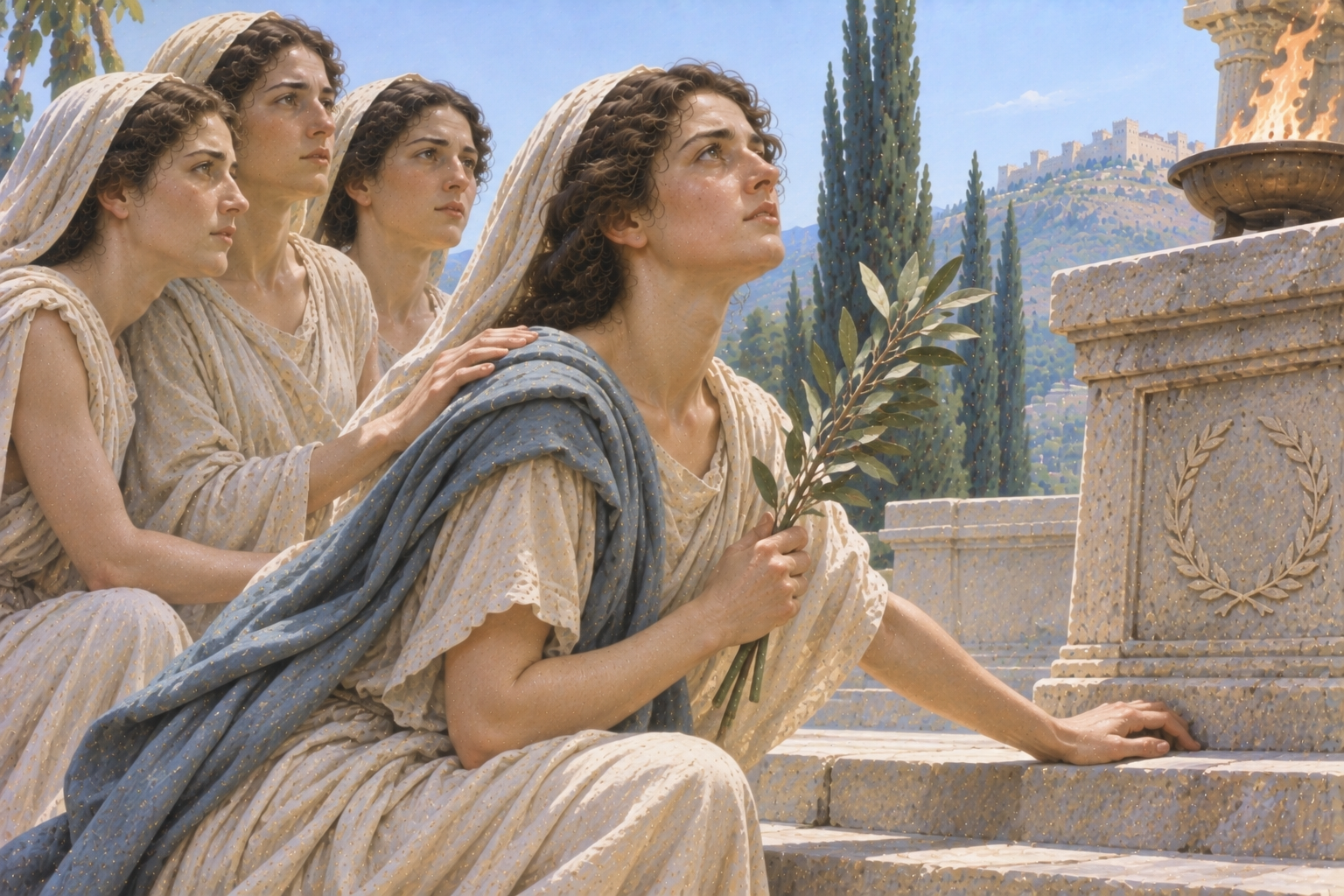
From Supplication to the Promise of Sanctuary
In Suppliant Women, Aeschylus builds a tragedy around a request for protection rather than a battle or an act of revenge. The fifty daughters of Danaus have fled Egypt to escape marriage to their cousins. Arriving in Argos, they seek refuge at a sacred sanctuary. Their appeal creates a conflict between religious obligation, political responsibility, and the threat of violence.
The play's dramatic movement follows the changing fortunes of the women as they seek a community willing to defend them.
Opening: The Danaids Arrive
The tragedy begins with the Danaids entering as a Chorus, accompanied by their father, Danaus. They carry the branches of suppliants and invoke the gods as they seek protection.
Their opening prayers establish their fear of being forced into unwanted marriages and their hope that Argos will receive them.
Unlike many Greek tragedies, the Chorus is not simply a group of observers. The Danaids themselves are the principal figures whose future is at stake.
Danaus and the Preparation for Supplication
Danaus advises his daughters on how to approach the Argive authorities. He emphasizes respectful speech and the importance of remaining near the sacred altars.
This scene establishes the practical and religious dimensions of supplication. The women's safety depends not only upon their need but also upon the willingness of others to recognize their claim to protection.
Pelasgus and the Difficult Decision
When Pelasgus, king of Argos, arrives, the Danaids explain their situation and their ancestral connection to the city through Io.
Pelasgus recognizes the seriousness of their appeal. Refusing protection could offend the gods, but granting it could expose Argos to war with the Egyptians.
The dramatic tension arises from this conflict between competing responsibilities. Pelasgus cannot offer an easy solution without placing others at risk.
The Decision of the Argive People
Pelasgus refers the question of sanctuary to the Argive citizens rather than deciding entirely on his own.
Danaus later reports that the people have voted to protect the women. Their decision transforms the Danaids' position from that of vulnerable strangers into people granted public protection.
This is an important turning point, but it does not remove the threat posed by their pursuers.
The Arrival of the Egyptian Herald
The danger becomes immediate when the Egyptian herald arrives and attempts to compel the women to return.
His threats contrast with the Danaids' appeals to religious protection. The conflict between force and sanctuary, previously discussed in political and moral terms, now unfolds directly before the audience.
Pelasgus intervenes and rejects the herald's attempt to seize the women.
The Ending: Protection Without Complete Resolution
The surviving play concludes with the Danaids under Argive protection, but the broader conflict remains unresolved.
The Egyptians have not abandoned their pursuit, and the possibility of warfare remains.
Because Suppliant Women belonged to a larger dramatic sequence whose other plays have been lost, students should distinguish the ending of the surviving tragedy from later events known through the wider mythological tradition.
How the Structure Creates Suspense
The play develops through a series of changes in the women's security:
- They arrive in danger and seek divine protection.
- They appeal to a ruler who hesitates because of the consequences.
- The Argive people agree to shelter them.
- Their pursuers arrive and threaten to seize them.
- Pelasgus defends their newly granted protection.
The movement from fear to hope and back to immediate danger gives the play its dramatic rhythm.
Aeschylus also uses the Chorus to sustain tension. The women's prayers, appeals, and emotional responses allow the audience to experience the crisis from the perspective of those most directly threatened.
Questions for Discussion
- How does beginning with the Danaids' arrival establish the central conflict?
- Why does Pelasgus hesitate before granting protection?
- How does the decision of the Argive people change the dramatic situation?
- Why is the Egyptian herald's arrival important after the promise of sanctuary?
- How does the Chorus shape the audience's understanding of the women's fears?
- In what sense does the play reach a conclusion, and in what sense does the conflict remain unresolved?
Note to the Educator
Encourage students to identify the principal turning points and consider how Aeschylus creates suspense without relying on a large number of individual characters or visible battles. The contrast between the Danaids' initial vulnerability, the Argive vote, and the herald's arrival provides a useful framework for examining dramatic structure.
Students may also compare this play's prominent Chorus with the more observational role of the Chorus in other Greek tragedies.
This guide accompanies the Richer Resources Publications edition of Suppliant Women, translated by Ian Johnston.
A printable PDF version of this resource is available by email.