Sanctuary, Freedom, and the Duties of Protection
In Suppliant Women, Aeschylus presents fifty sisters who flee Egypt and seek refuge in Argos rather than submit to marriages they reject. Their appeal forces the king and citizens of Argos to consider the obligations owed to strangers, the authority of religious custom, and the dangers of defending people pursued by powerful enemies.
The tragedy explores these questions through recurring themes and symbols that give the women's plea both personal and public significance.
Sanctuary and the Protection of Strangers
The Danaids arrive as suppliants, seeking safety under the protection of the gods. Their appeal is not simply a request for kindness. In ancient Greek religious practice, supplication created serious obligations for those asked to provide protection.
Pelasgus recognizes the danger of refusing the women, but he also fears that accepting them may lead to war.
The play asks whether a community's duty to protect vulnerable strangers should prevail when fulfilling that duty threatens its own security.
Freedom and Resistance to Forced Marriage
The Danaids reject marriage to the sons of Aegyptus and flee to escape their pursuers.
Their resistance raises questions about consent, personal freedom, and the authority claimed by male relatives. Yet the play does not present a simple modern argument about individual rights. The sisters also rely upon their father, their ancestry, and divine protection to support their appeal.
Students should distinguish the Danaids' rejection of these particular marriages from broader claims about marriage in general.
Family, Ancestry, and Belonging
The Danaids appeal to their descent from Io, whose story connects their family to Argos.
This ancestral relationship becomes an important part of their argument for protection. Although they arrive from Egypt, they claim a meaningful connection to the land and its people.
The theme invites students to consider how communities define belonging and whether shared ancestry should determine who deserves protection.
Religious Duty and Political Responsibility
Pelasgus must weigh religious obligations against the possibility of military conflict.
His decision to consult the Argive people makes the question of sanctuary a matter of public responsibility rather than private generosity.
Aeschylus presents a tension between doing what appears morally and religiously necessary and accepting the consequences that may follow.
The Chorus as a Collective Voice
The Danaids themselves form the Chorus, making their fears and hopes central to the dramatic action.
Their prayers, arguments, and expressions of distress remind the audience that the question of sanctuary concerns real human suffering.
Because the sisters speak collectively, students can examine how Aeschylus creates a shared identity while leaving room for questions about individual motives and experiences.
The Suppliants' Branches
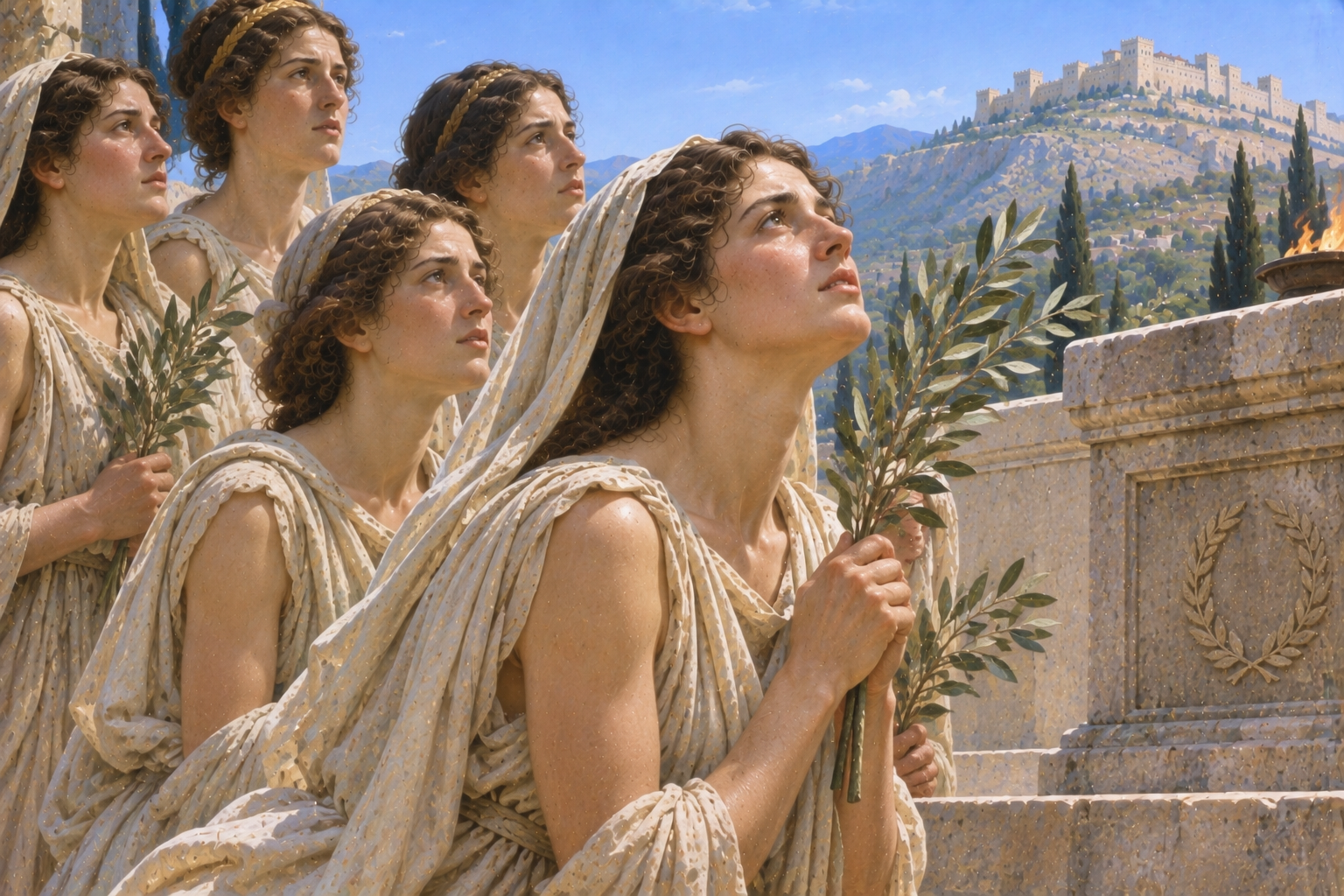
The branches carried by the Danaids are visible signs of their status as suppliants. Traditionally associated with ritual appeals for protection, such branches make the women's request recognizable before they explain it in words.
They symbolize vulnerability, religious obligation, and the seriousness of refusing sanctuary.
The branches also transform the women's physical presence into a public appeal that Pelasgus cannot easily ignore.
The Sacred Altars
The Danaids gather at a sanctuary and seek protection near the altars of the gods.
These sacred places represent a boundary between ordinary political power and religious duty. Violence against people seeking refuge there would carry consequences beyond the immediate conflict.
The altars therefore become a setting in which the competing claims of force, justice, and divine authority are brought into direct confrontation.
The Egyptian Herald
The Egyptian herald embodies the threat from which the women have fled. His attempt to seize them contrasts with the protection they seek through religious custom.
His arrival turns the abstract question of sanctuary into an immediate test of Pelasgus' commitment.
The confrontation emphasizes the difference between authority exercised through coercion and authority exercised through restraint and responsibility.
Questions for Discussion
- Why does the Danaids' status as suppliants make their appeal especially serious?
- How does the play distinguish the women's wishes from the authority claimed by their pursuers?
- Why is the Danaids' connection to Io important to their request for protection?
- What do the branches and sacred altars communicate without words?
- Why does Pelasgus involve the Argive citizens in the decision?
- How does the Egyptian herald sharpen the contrast between protection and coercion?
- Does the decision to shelter the Danaids resolve the conflict, or does it create new responsibilities?
Note to the Educator
Encourage students to distinguish the religious meaning of supplication in ancient Greece from modern legal ideas about asylum. The comparison can be productive, but the historical differences are important.
The branches and altars offer useful starting points for close reading because they make the Danaids' request visible before its political consequences are fully understood. Students may also consider how the Chorus' collective voice shapes their sympathy for the women.
This guide accompanies the Richer Resources Publications edition of Suppliant Women, translated by Ian Johnston.
A printable PDF version of this resource is available by email.