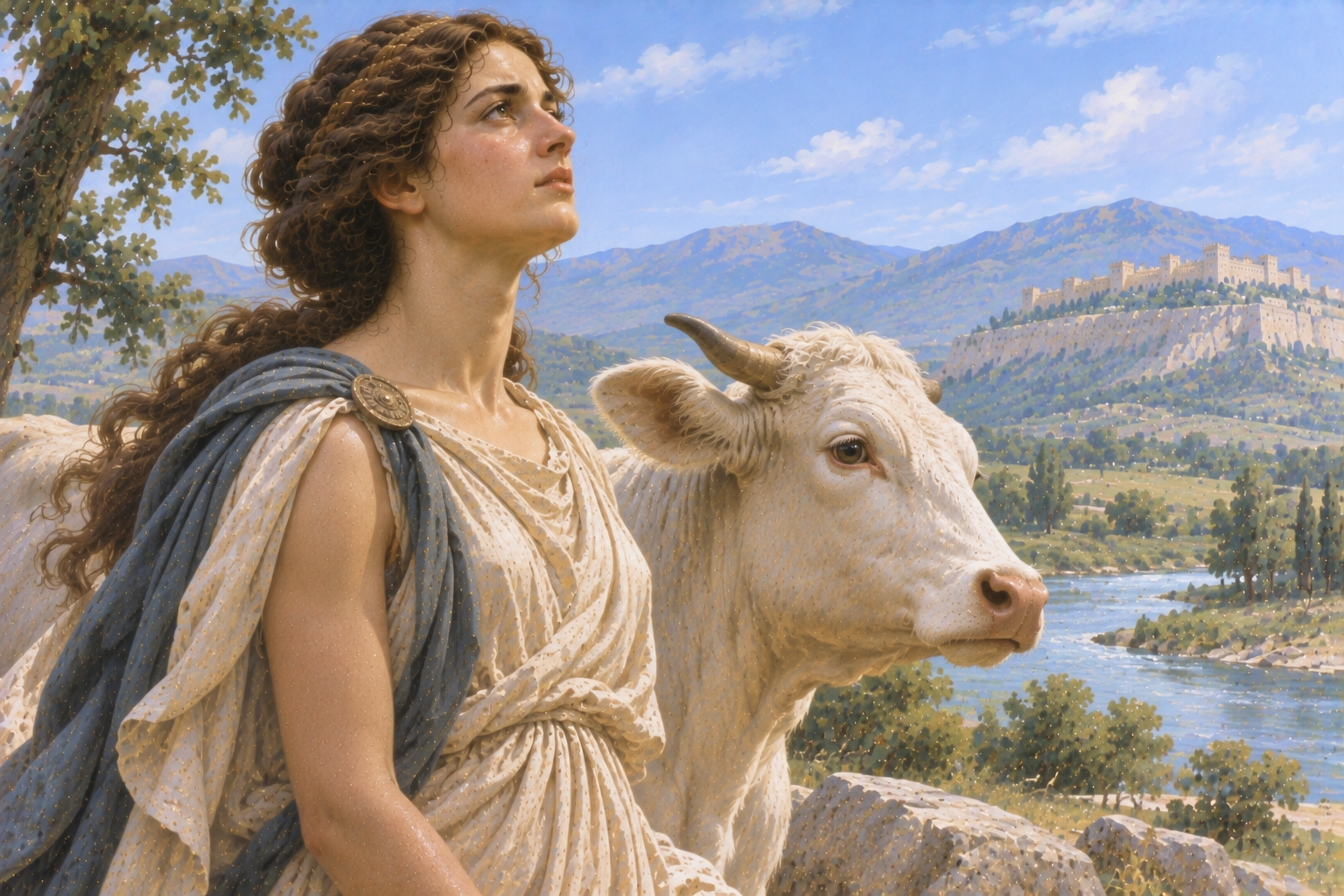
Io, the Danaids, and the Origins of a Family Conflict
Aeschylus’ Suppliant Women draws upon a mythological history connecting Argos and Egypt through the descendants of Io. Understanding this background helps explain why the Danaids appeal to the Argives as relatives, why their pursuers claim authority over them, and why their request for sanctuary carries both religious and political significance.
Io and the Argive Ancestry
Io was a figure associated with Argos and the god Zeus. In Greek mythology, she was transformed into a cow and driven through distant lands during a period of extraordinary suffering.
Her wanderings eventually brought her to Egypt, where she became the ancestor of a family whose descendants included Danaus and Aegyptus.
For the Danaids, Io's story establishes a connection to Argos despite their arrival from Egypt. They invoke this ancestry when seeking recognition and protection from Pelasgus.
Danaus, Aegyptus, and Their Children
According to the wider mythological tradition, Danaus and Aegyptus were brothers. Danaus had fifty daughters, known as the Danaids, while Aegyptus had fifty sons.
The sons of Aegyptus sought marriage with their cousins. The Danaids resisted these marriages and fled with their father.
Their journey to Argos establishes the central situation of Suppliant Women: a group of women seeking protection from men who intend to compel their return.
Why Argos Matters
Argos is more than a convenient destination. Through Io, the Danaids claim ancestral ties to the region.
Their appeal challenges the distinction between strangers and members of a community. Although they arrive from another land, they argue that their family history gives them a legitimate claim upon Argive hospitality.
This ancestry also strengthens the religious dimension of their request, since Io's story is closely connected with Zeus.
Zeus and the Protection of Suppliants
Zeus held an important place in Greek religious ideas about supplication and the treatment of strangers.
The Danaids repeatedly invoke divine protection as they seek refuge at the sacred altars.
Their prayers remind Pelasgus that refusing protection is not simply a political decision. It may also violate obligations understood to be sacred.
The mythological background therefore reinforces the play's central conflict between religious duty and the danger of war.
The Later Story of the Danaids
In the wider mythological tradition, the conflict between the families eventually leads to the marriage of the Danaids to the sons of Aegyptus.
One well-known version relates that forty-nine of the sisters kill their husbands on their wedding night, while Hypermnestra spares hers.
Other traditions describe the punishment of the Danaids in the underworld, where they must endlessly attempt to fill a vessel that cannot retain water.
These episodes belong to the larger mythological tradition. They are not events depicted in the surviving text of Suppliant Women.
Aeschylus is believed to have treated further developments of the story in companion plays that have not survived intact. The precise details of those lost dramas remain uncertain.
Mythology and the Meaning of the Tragedy
The mythological background deepens several important questions:
- Does shared ancestry create obligations between communities?
- How does the story of Io strengthen the Danaids' appeal?
- What authority do religious traditions give to people seeking sanctuary?
- How does knowledge of the wider myth affect an audience's expectations?
- Why should readers distinguish the surviving play from later versions of the story?
Aeschylus transforms a family legend into a drama about protection, consent, political responsibility, and the limits of power.
Questions for Discussion
- Why do the Danaids emphasize their descent from Io?
- How does Io's journey connect Egypt and Argos?
- What role does Zeus play in the Danaids' understanding of sanctuary?
- How does the family relationship between Danaus and Aegyptus complicate the conflict?
- Why is it important to distinguish events in the surviving tragedy from later episodes in the myth?
- How might an ancient audience familiar with the wider story have understood the Danaids' fears differently from a modern reader encountering the play for the first time?
Note to the Educator
Encourage students to create a simple family tree tracing the connection from Io to Danaus, Aegyptus, and their children. This can clarify why the Danaids regard Argos as an ancestral homeland.
When discussing the later myth of the Danaids, distinguish carefully between what Aeschylus actually presents in the surviving play and what is known from other traditions. The contrast provides a useful opportunity to explore how playwrights adapt inherited stories.
This guide accompanies the Richer Resources Publications edition of Suppliant Women, translated by Ian Johnston.
A printable PDF version of this resource is available by email.