Prepared for the Richer Resources Classical Reference Library
Editorial Note. This resource reproduces Johnston’s chronological summary of the Trojan War legend together with his discussion of its cultural influence. The separate section “The Royal House of Atreus” has been omitted for publication as an independent reference resource. Johnston released the original document into the public domain in May 1999.
This summary, which has been prepared by Ian Johnston of Malaspina University-College, Nanaimo, BC (now Vancouver Island University), for students in Classics 101 and Liberal Studies, is a brief account of a number of different old stories about the Trojan war, arranged in more or less chronological sequence. There are several different, even contradictory, versions of events. There is no one authoritative narrative of the whole war.
Many of these stories were obviously current before Homer, and the story continued to be embellished by the Romans and Medieval writers.
1. The gods Apollo and Poseidon, during a time when they were being punished by having to work among men, built the city of Troy for Priam's father, Laomedon. They invited the mortal man Aeacus (the son of Zeus and Aegina and grandfather of Achilles) to help them, since destiny had decreed that Troy would one day be captured in a place built by human hands (so a human being had to help them).
2. When newly constructed, Troy was attacked and captured by Herakles (Hercules), Telamon (brother of Peleus and therefore the uncle of Achilles and father of Telamonian Ajax and Teucros), and Peleus (son of Aeacus and father of Achilles), as a punishment for the fact that Laomedon had not given Hercules a promised reward of immortal horses for rescuing Laomedon's daughter Hesione. Telamon killed Laomedon and took Hesione as a concubine (she was the mother of Teucros).
3. Priam, King of Troy and son of Laomedon, had a son from his wife Hekabe (or Hecuba), who dreamed that she had given birth to a flaming torch. Cassandra, the prophetic daughter of Priam, foretold that the new-born son, Paris (also called Alexandros or Alexander), should be killed at birth or else he would destroy the city. Paris was taken out to be killed, but he was rescued by shepherds and grew up away from the city in the farms by Mount Ida. As a young man he returned to Troy to compete in the athletic games, was recognized, and returned to the royal family.
4. Peleus (father of Achilles) fell in love with the sea nymph Thetis, whom Zeus, the most powerful of the gods, also had designs upon. But Zeus learned of an ancient prophecy that Thetis would give birth to a son greater than his father, so he gave his divine blessing to the marriage of Peleus, a mortal king, and Thetis. All the gods were invited to the celebration, except, by a deliberate oversight, Eris, the goddess of strife. She came anyway and brought a golden apple, upon which was written 'For the fairest.' Hera, Aphrodite, and Athena all made a claim for the apple. The task of choosing a winner fell to Paris. Hera offered power, Athena offered military glory and wisdom, and Aphrodite offered him the most beautiful woman in the world as his wife. Paris gave the apple to Aphrodite.
5. Helen, daughter of Tyndareus and Leda, was also the daughter of Zeus, who had made love to Leda in the shape of a swan. Her beauty was famous throughout the world. Her father Tyndareus would not agree to any man's marrying her until all the Greek warrior leaders promised that they would collectively avenge any insult to her. Helen then married Menelaus, King of Sparta. Her twin sister Klytaimnestra (Clytaemnestra) married Agamemnon, King of Argos, and brother of Menelaus.
6. Paris, back in the royal family at Troy, made a journey to Sparta as a Trojan ambassador, at a time when Menelaus was away. Paris and Helen fell in love and left Sparta together, taking with them a vast amount of the city's treasure. When the Trojans refused a Greek demand for Helen and the treasure, the Greeks appealed to their oath and assembled an army to invade Troy. Some stories claimed that the real Helen never went to Troy, for she was carried off to Egypt by Hermes, and Paris took her double to Troy.
7. Achilles, the son of Peleus and Thetis, was educated by Chiron, the centaur. To protect him from death in battle his mother bathed the infant in the waters of the river Styx, which conferred invulnerability to any weapon. When the Greeks began to assemble an army, Achilles's parents hid him at Scyros disguised as a girl. Odysseus found Achilles by tricking him. Menoitios sent his son Patroclus to accompany Achilles on the expedition as his friend and advisor.
8. The Greek fleet of one thousand ships assembled at Aulis. The army was delayed by contrary winds after Agamemnon offended Artemis. In desperation to appease the goddess, Agamemnon sacrificed his daughter Iphigeneia. One version claims that Artemis saved her at the last minute and carried her off to Tauris. After the sacrifice Artemis changed the winds, and the fleet sailed for Troy.
9. On the way to Troy, Philoctetes, the son of Poeas and leader of the seven ships from Methone, suffered a snake bite when the Greeks landed at Tenedos to make a sacrifice. His pain was so great and his wound so unpleasant that the Greek army abandoned him against his will on the island.
10. The Greek army landed on the beaches before Troy. The first man ashore, Protesilaus, was killed by Hector. The Greeks sent another embassy to Troy, seeking to recover Helen and the treasure. When the Trojans denied them, the Greek army settled down into a siege which lasted many years.
11. In the tenth year of the war (where the narrative of the Iliad begins), Agamemnon insulted Apollo by taking as a slave-hostage the girl Chryseis and refusing to return her. Apollo sent nine days of plague upon the Greek army. Achilles and Agamemnon quarrelled bitterly; Agamemnon confiscated Achilles's slave girl Briseis, and Achilles withdrew himself and the Myrmidons from the war. He asked Thetis to persuade Zeus to give the Trojans help in battle so the Greeks would recognize how foolish Agamemnon had been.
12. During the war numerous incidents took place. Paris and Menelaus fought a duel, and Aphrodite saved Paris. Achilles slew Cycnus, Troilus, and many others. Odysseus and Diomedes slaughtered thirteen Thracians and stole the horses of King Rhesus. Telamonian Ajax and Hector fought a duel with no decisive result. Thersites challenged Agamemnon and demanded that the soldiers abandon the expedition; Odysseus beat him into obedience. In Achilles's absence Hector enjoyed great success and reached the Greek ships.
13. The Greeks sent an embassy to Achilles requesting his return. Achilles refused Agamemnon's compensation but said he would reconsider if Hector reached the ships. When Hector did so, Patroclus begged to return to the fight wearing Achilles's armour. Patroclus enjoyed great success but was finally killed by Hector, with the help of Apollo.
14. In grief over Patroclus, Achilles returned to battle. Thetis asked Hephaestus to make divine armour for him. Achilles slaughtered many Trojans and finally killed Hector outside the walls of Troy. He mutilated Hector's corpse and dragged it away. Priam later came to the Greek camp to plead for his son's body, and Achilles returned it in exchange for a ransom.
15. In the tenth year the Amazons, led by Queen Penthesilea, joined the Trojans. She was killed by Achilles, as was King Memnon of Ethiopia. Achilles himself was then killed by Paris, with Apollo's help, by an arrow in the heel. At Achilles's funeral the Greeks sacrificed Polyxena. Odysseus and Telamonian Ajax fought over Achilles's armour; Ajax lost, went mad, and committed suicide.
16. The Greeks captured Helenus, a son of Priam and prophet of Troy. He revealed that Troy could not be captured without Philoctetes, owner of the bow and arrows of Hercules. Odysseus and Neoptolemus persuaded him to return. Philoctetes killed Paris with an arrow from Hercules's bow.
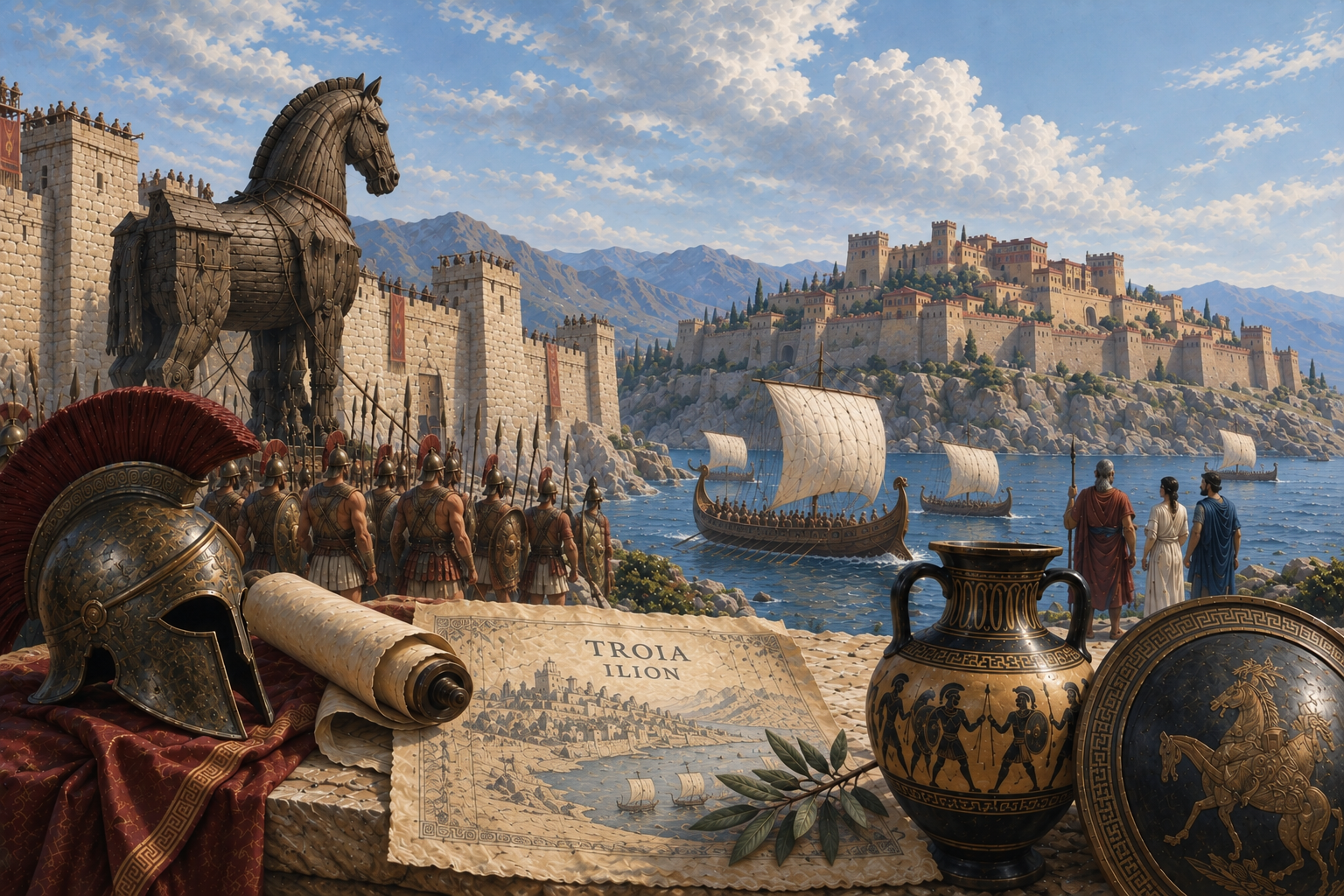
17. Odysseus and Diomedes entered Troy at night in disguise and stole the Palladium, the sacred statue of Athena. Finally the Greeks devised the wooden horse filled with armed soldiers. The army withdrew to Tenedos as if abandoning the war. Sinon remained behind and persuaded the Trojans that the horse was an offering to Athena. Laocoon warned them not to trust the Greeks, but a sea monster killed Laocoon and his sons.
18. The Trojans dragged the horse into their city and celebrated. At night the Greek soldiers hidden inside emerged, opened the gates, and signalled the army. Troy was destroyed. Priam was slaughtered by Neoptolemus. Hector's infant son Astyanax was thrown from the battlements. Hecuba, Cassandra, and Andromache were taken prisoner. Helen was returned to Menelaus.
19. The gods regarded the sacking of Troy and especially the treatment of the temples as sacrilege and punished many Greek leaders. Menelaus wandered for seven years. Agamemnon returned to Argos, where he and Cassandra were murdered by Clytaemnestra and Aegisthus. Aegisthus sought revenge for Atreus's treatment of Thyestes, while Clytaemnestra claimed revenge for the sacrifice of Iphigeneia.
20. Odysseus (Ulysses) wandered for ten years before reaching home, losing all his men. His adventures took him among the Cicones, Lotus Eaters, Cyclops, Aeolus, Laestrygonians, Circe, the underworld, Sirens, Scylla and Charybdis, the cattle of Helios, Calypso, and Phaeacia. Back in Ithaca in disguise, with Telemachus and loyal servants, he killed Penelope's suitors and proved his identity through his bow and the secret of the marriage bed.
21. After Agamemnon's murder, Orestes returned with Pylades to avenge his father. With Electra's help he killed Clytaemnestra and Aegisthus and was pursued by the Furies. He fled to Delphi and, in some versions, to Tauris, where he met Iphigeneia. At Athens he was tried for matricide. Athena cast the deciding vote in his favour, and the Furies were placated and renamed the Eumenides.
22. Neoptolemus, the son of Achilles, married Hermione, daughter of Helen and Menelaus, and also took Hector's widow Andromache as a wife. Orestes, who had wished to marry Hermione, arranged matters so that the people of Delphi killed Neoptolemus, then carried off Hermione and married her. Andromache later married Helenus; Pylades married Electra.
23. Aeneas, son of Anchises and Aphrodite and an important Trojan leader, escaped the destruction of Troy carrying his father Anchises, his son Ascanius, and the ancestral gods. He wandered through the Mediterranean, including Carthage, where he had an affair with Queen Dido. He eventually reached Italy and fought Turnus. He founded Lavinium, linking the royal house of Troy with the future Roman people.
The Cultural Influence of the Legend of the Trojan War
No story in our culture, with the possible exception of the Old Testament and the story of Jesus Christ, has inspired writers and painters over the centuries more than the Trojan War. It was the fundamental narrative in Greek education, and all the tragedians whose works survive wrote plays upon various aspects of it. No one authoritative work defines all the details of the story.
Unlike narratives codified in a single authoritative version, the Trojan War exists as a large collection of different versions of the same events. It has been interpreted as heroic tragedy, fanciful romance, satire against warfare, love story, and passionately anti-war tale. Homer's poems enjoyed unique authority, but they tell only a small part of the total story.
The most famous Greek literary stories of the war are Homer's Iliad and Odyssey. The Iliad follows the wrath of Achilles, his withdrawal from the war, and his return; the Odyssey tells the return of Odysseus. Their extraordinary quality and authority are a major reason for the enduring popularity of the Trojan cycle. The Iliad also inspired Schliemann's nineteenth-century archaeological search for Troy.
The Greek tragedians repeatedly turned to the Trojan cycle. Aeschylus's Oresteia tells of Agamemnon's murder, Orestes's revenge, and his trial. Sophocles and Euripides both wrote about Electra; Euripides also treated The Trojan Women, Orestes, Helen, and Iphigeneia in Tauris, while Sophocles wrote Philoctetes and Ajax.
Greek philosophers and historians also used the Trojan War to explore human conduct. Herodotus and Thucydides discussed its origins; Plato's Republic repeatedly invokes Homer. Alexander the Great famously carried a copy of the Iliad with him.
The Romans adopted the story, most famously in Virgil's Aeneid. Medieval, Renaissance, and later writers continued to reinterpret it, often altering major characters. Dante includes Ulysses and Diomedes in the Inferno; Chaucer and Shakespeare both treated Troilus and Cressida. Modern writers drawing on the tradition include Sartre, O'Neill, Giraudoux, Joyce, Eliot, Auden, and many others.
The story has also provided material for opera, ballet, television, film, and countless modern adaptations. At the same time, translations of Homer and other ancient sources have steadily increased their direct readership, keeping both the ancient texts and the larger Trojan tradition current.
Source Note
Ian Johnston, “The Legend of the Trojan War,” prepared for students in Classics 101 and Liberal Studies at Malaspina University-College (now Vancouver Island University). Released into the public domain in May 1999. The original document states that it may be used in whole or in part without permission or charge provided the source is acknowledged.