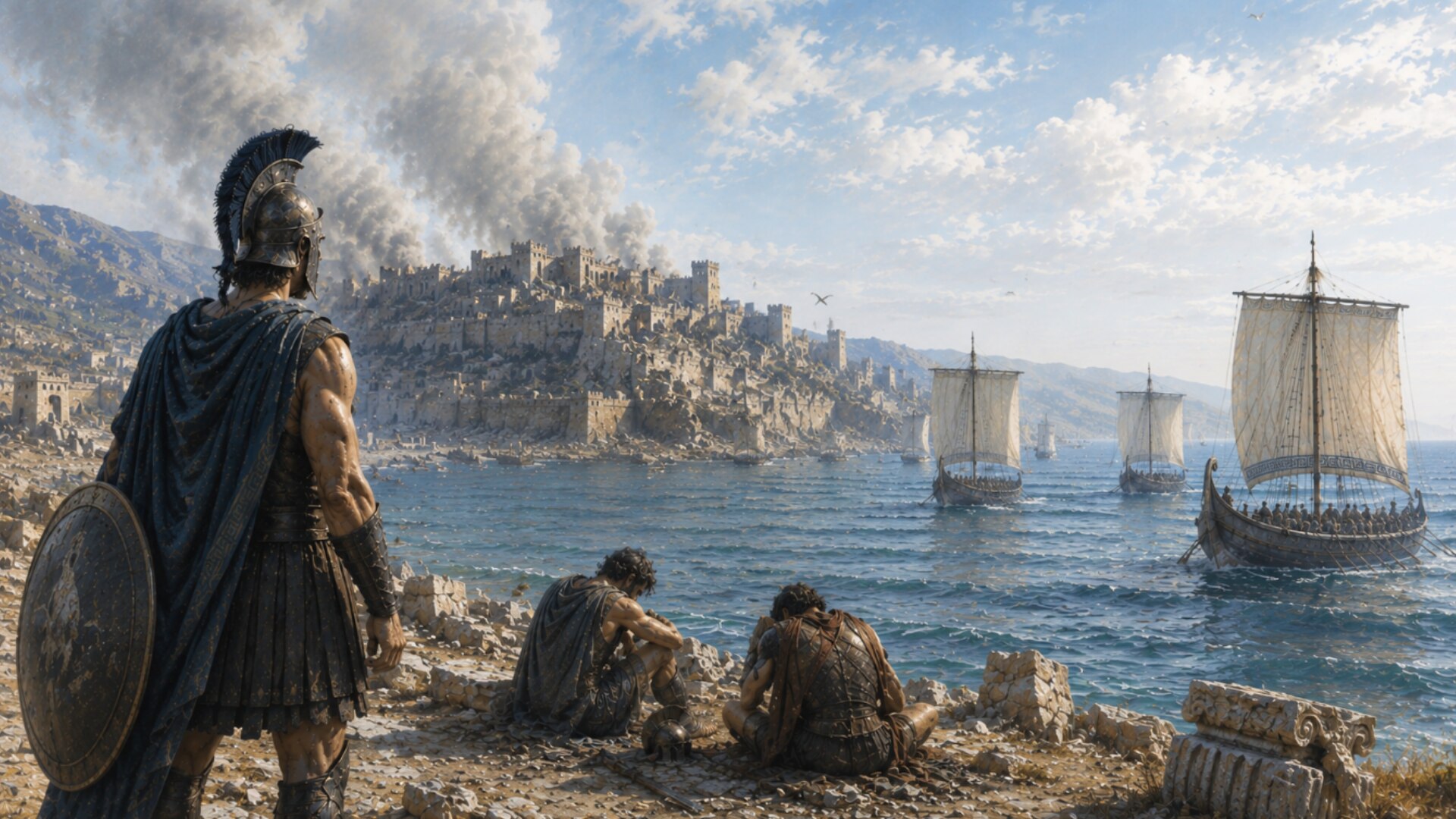
Ask who won the Trojan War and the obvious answer is the Greeks.
After ten years of fighting, Troy fell. The Greek army breached the city through the deception of the Trojan Horse, Troy’s warriors were defeated, its royal family was destroyed, and the surviving Greek forces sailed for home.
By the ordinary rules of warfare, there is not much room for debate.
And yet the ancient Greeks themselves told the story very differently.
Read the Iliad, the Odyssey, and the tragedies that grew out of the Trojan War, and something peculiar happens. The more of the story we learn, the harder it becomes to identify anyone who actually won.
The Greeks Take Troy
The war begins, according to the traditional story, when Paris, a Trojan prince, takes Helen, the wife of Menelaus, king of Sparta, back to Troy.
Menelaus’s brother Agamemnon leads a vast Greek expedition across the Aegean. Among its warriors are some of the greatest names in Greek legend: Achilles, Odysseus, Ajax, Diomedes and Nestor.
For ten years they fight outside Troy.
The Iliad does not actually tell us about the fall of the city. Its action occupies only a brief period during the final year of the war and ends while Troy is still standing. But the larger tradition carries the story forward.
Achilles dies. Paris dies. Eventually Odysseus devises the stratagem of the wooden horse. The Greeks appear to sail away, leaving the horse behind. The Trojans bring it inside their walls.
Greek soldiers hidden within it emerge during the night.
Troy falls.
If history stopped there, the Greeks would unquestionably be the victors.
But Greek mythology does not stop there.
The Price of Victory
The destruction of Troy is brutal even by the standards of ancient warfare.
Priam, the elderly king of Troy, is killed. Hector is already dead. Trojan women are divided among the victorious Greeks. Hector’s widow Andromache becomes a captive. Cassandra is taken by Agamemnon. The child Astyanax, Hector’s son, is killed so that he cannot grow up to avenge his father and rebuild Troy.
The Greeks have achieved what they came to accomplish.
But their victory has begun to look remarkably like catastrophe.
And the catastrophe follows them home.
The Victors Who Cannot Go Home
Agamemnon returns to Mycenae as commander of the victorious Greek expedition.
Almost immediately, he is murdered.
His wife, Clytemnestra, has neither forgotten nor forgiven what happened before the fleet ever reached Troy. Agamemnon sacrificed their daughter Iphigenia so that the Greek ships could sail. While he was away, Clytemnestra took Aegisthus as her lover.
The great commander survives ten years of war only to die after reaching his own palace.
His homecoming begins another cycle of violence. His son Orestes eventually kills Clytemnestra to avenge his father and is then pursued by the Furies for murdering his mother.
Victory at Troy has not ended violence.
It has brought the violence home.
Odysseus Wins—and Wanders
Odysseus fares better, although not immediately.
His intelligence helps make the Greek victory possible. Yet his reward is another ten years of wandering.
His ships are destroyed. His companions die. He is imprisoned or detained far from home. Poseidon persecutes him. By the time Odysseus finally reaches Ithaca, he has been absent for twenty years and returns to find his household overrun by men competing to marry his wife and consume his property.
He eventually regains his home, his kingdom and his family.
But Homer makes us wait a very long time before allowing us to call that victory.
What About the Trojans?
The Trojans unquestionably lose the war.
Their city is destroyed and their civilization, as Homer knew it, disappears.
Yet even here Greek and Roman tradition complicates the idea of defeat.
The Trojan prince Aeneas escapes the destruction. Centuries later, the Roman poet Virgil makes that defeated refugee the hero of the Aeneid. Aeneas carries the future with him out of the ruins of Troy and eventually reaches Italy, where his descendants will be connected to the foundation of Rome.
In Virgil’s telling, Troy loses its city but not its future.
The defeated become the legendary ancestors of the greatest power in the Mediterranean world.
That is an extraordinary reversal.
Achilles Chooses a Different Kind of Victory
And then there is Achilles.
The greatest Greek warrior never sees Troy fall.
He knows that he faces a choice. He can return home and live a long, largely uncelebrated life, or remain at Troy, die young and win imperishable fame.
He chooses fame.
By one measure, Achilles therefore wins exactly what he sought. He dies, but nearly three thousand years later we still know his name.
Yet the Iliad itself makes that victory deeply uncomfortable.
Achilles loses Patroclus, the person closest to him. His grief turns into terrible rage. He kills Hector and abuses his body. Only when the elderly Priam enters the Greek camp and begs for the return of his son does Achilles confront grief that mirrors his own.
The poem ends not with conquest, but with a funeral.
Hector’s funeral.
A Greek epic about war closes by asking its audience to mourn a Trojan.
So Who Won?
Militarily, the answer remains simple.
The Greeks won the Trojan War.
But the stories the Greeks told about that victory suggest they understood something more complicated about war.
Troy is annihilated. Achilles is dead. Ajax is dead. Agamemnon comes home only to be murdered. Menelaus and Helen endure years of wandering before reaching Sparta. Odysseus loses every man who sailed home with him and spends ten more years trying to reach Ithaca. The children of the victors inherit feuds created by their parents.
Even the gods quarrel over what happened.
Perhaps that is why the Trojan War remained such fertile ground for Greek poets and dramatists. It offered them something more interesting than a story about winners and losers.
It allowed them to ask what winning actually means.
A city can be captured. An enemy can be defeated. An army can sail home carrying treasure.
But if the victors return traumatized, divided, bereaved and pursued by the consequences of what they have done, how complete is their victory?
Nearly three thousand years later, that question has lost none of its force.
The Greeks won Troy.
The ancient stories leave us to decide whether anyone won the war.