Skip to content

GREEK TRAGEDY · THEMES & SYMBOLISM

Themes and Symbols in Aeschylus’ The Persians

Imperial ambition, divine limits, and the human cost of defeat

By Richer Resources Editorial Team


Imperial Ambition, Grief, and the Limits of Human Power

Aeschylus’ The Persians explores the defeat at Salamis through the fears and losses of the Persian court. Its recurring images of restraint, crossing, and destruction give shape to questions about leadership and the consequences of imperial ambition.

Imperial Ambition and the Limits of Power

The Persian expedition is presented as an undertaking whose scale exceeds prudent limits. Darius’ ghost interprets Xerxes’ actions as an example of human arrogance before divine authority. Students should distinguish this dramatic judgment from a complete historical explanation of the war.

Atossa’s Dream: Two Women and a Broken Yoke

Atossa dreams of two women, one associated with Persia and the other with Greece. Xerxes attempts to harness them to his chariot. One submits, but the other resists and breaks the yoke. The dream anticipates the failed effort to bring Greece under Persian control, while making conquest visible as an attempt to restrain another people.

The Hellespont: Binding the Sea

Xerxes’ bridging of the Hellespont becomes a central symbol of overreaching power. Darius condemns the attempt to constrain the waters, connecting the king’s military ambition to a violation of natural and divine boundaries. The image raises the question of what rulers may legitimately command.

Ships, the Sea, and Reversal

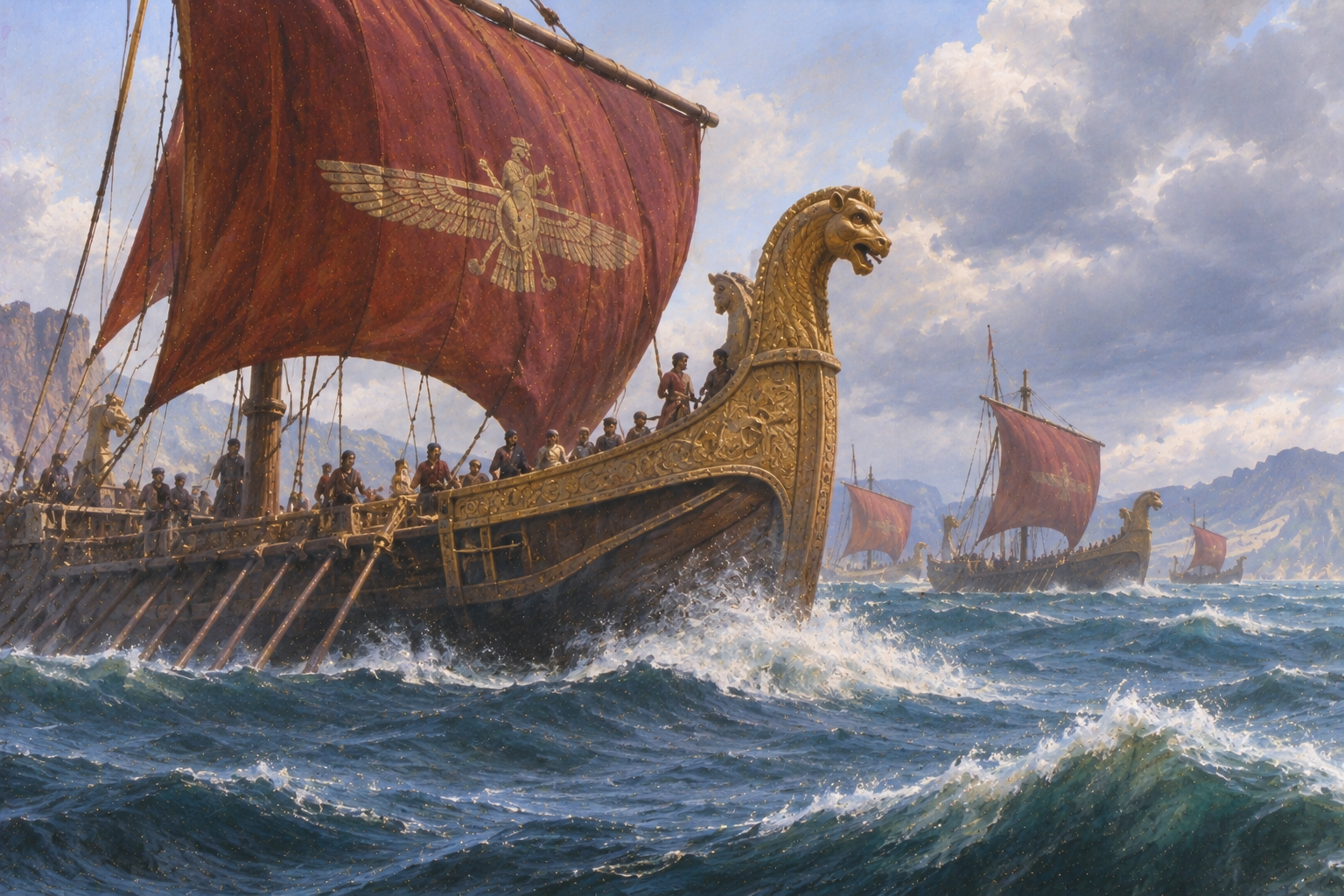
The fleet initially represents Persian wealth, reach, and military strength. In the messenger’s account of Salamis, the sea becomes the setting of catastrophe. The destruction of ships reverses the expected meaning of imperial power: the instruments of conquest become evidence of vulnerability.

Grief and the Cost of War

The Chorus mourns the many men lost in battle, while Atossa fears for her son and kingdom. The repeated laments make national defeat an intimate human experience. Xerxes’ final entrance, without the triumph expected of a conquering king, brings the cost of his decisions into view.

Leadership and Responsibility

Xerxes’ absence through most of the play means that others describe and assess his actions before he speaks. The messenger narrates what occurred; Darius assigns moral responsibility; the Chorus registers communal loss. These different voices invite students to ask how leaders should be judged after disaster.

Questions for Discussion

  1. How does Atossa’s dream represent the conflict between conquest and resistance?
  2. Why does the image of binding the Hellespont matter to Darius’ criticism of Xerxes?
  3. How does the meaning of the Persian fleet change after Salamis?
  4. What is the effect of presenting the war through the defeated community?
  5. How do the messenger, Darius, and the Chorus explain the disaster differently?
  6. Does the play criticize Persian people, imperial overconfidence, or both? Support your answer.

Note to the Educator

Invite students to follow one symbol from its first appearance to its later interpretation. Atossa’s dream and the Hellespont are especially useful for distinguishing literal events from the meanings attached to them. Encourage students to recognize the Persian perspective without assuming that the play is an impartial historical account.
This guide accompanies the Richer Resources Publications edition of The Persians, translated by Ian Johnston.
A printable PDF version of this resource is available by email. 

Free PDF by Email

Available free to educators by email.

More from the Reference Library

You may also be interested in…

GREEK TRAGEDY • BACKGROUND GUIDE

Greek Tragedy and the Gods

An accessible guide to the role of the gods in Greek tragedy, examining divine authority, oracles, prophecy, sacred obligations, ritual, justice, and human responsibility. Includes examples from Sophocles and Euripides, close-reading questions, and a classroom activity distinguishing characters’ beliefs from dramatic evidence.

Read resource →

GREEK TRAGEDY • BACKGROUND GUIDE

Structure of a Greek Tragedy

A clear introduction to the structure of ancient Greek tragedy, explaining the prologue, parodos, episodes, stasima, and exodos. Includes additional dramatic terms, a simplified performance sequence, an example from Sophocles’ Antigone, close-reading questions, and a classroom exercise.

Read resource →

GREEK TRAGEDY • BACKGROUND GUIDE

The Chorus in Greek Tragedy

An accessible guide to the Chorus in ancient Greek tragedy, explaining its role as a collective voice, dramatic participant, and performer of choral odes. Includes examples from Antigone, Oedipus the King, and Medea, along with reading strategies, discussion questions, and a classroom activity.

Read resource →