Introduction: Teaching Diderot Through Dialogue
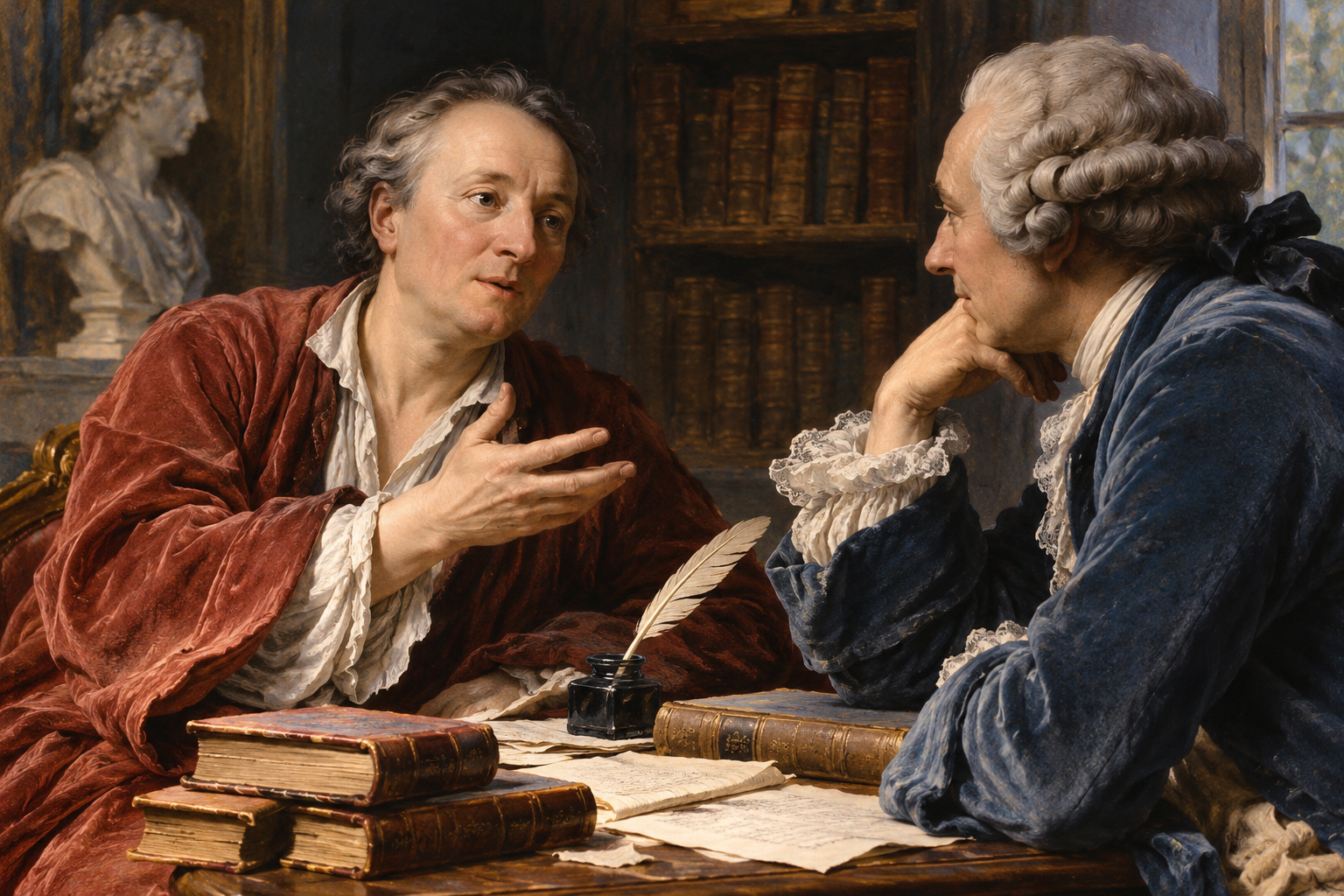
Denis Diderot’s D’Alembert’s Dream and Rameau’s Nephew offer two strikingly different forms of philosophical conversation. The first explores matter, life, consciousness, and the relation between body and mind. The second examines talent, morality, social status, and the compromises people make to survive. Together they invite students to question accepted explanations rather than memorize a settled system.
Historical and Intellectual Context
Diderot (1713–1784) was a central figure of the French Enlightenment and co-editor of the Encyclopédie. His dialogues often test provocative ideas through characters who disagree, interrupt, or expose one another’s contradictions.
D’Alembert’s Dream was composed in 1769 and circulated privately; Rameau’s Nephew was written and revised over a number of years and appeared posthumously. Their unusual publication histories offer a useful opening for discussing intellectual freedom and censorship.
The Two Works at a Glance
D’Alembert’s Dream: A sequence of linked conversations involving Diderot, d’Alembert, Julie de Lespinasse, and the physician Bordeu. Its central questions concern living matter, sensation, bodily organization, and whether thought can arise from material processes.
Rameau’s Nephew: A dialogue between “I” and “He,” the eccentric nephew of the composer Jean-Philippe Rameau. Their exchange exposes tensions between artistic genius and social dependence, virtue and self-interest, and public respectability and private conduct.
Major Themes
Matter and consciousness. In D’Alembert’s Dream, consider how Diderot imagines living systems developing from organized matter. Students should distinguish a speculative philosophical model from a modern scientific finding.
Dialogue as inquiry. Neither work is a straightforward lecture. Ask how conflicting voices, irony, and shifting positions prevent easy conclusions.
Morality and social performance. In Rameau’s Nephew, the nephew’s candor about flattery, money, and dependence raises the question of whether exposing hypocrisy amounts to defending it.
Art, genius, and patronage. Discuss how artistic achievement may depend on social institutions that reward conformity or opportunism.
Learning Objectives
By the end of the unit, students should be able to:
- Explain how Diderot uses dialogue rather than systematic exposition to explore philosophical problems.
- Identify the materialist questions raised in D’Alembert’s Dream.
- Analyze the conflicting views of morality and social success in Rameau’s Nephew.
- Support interpretations with specific exchanges and distinguish a speaker’s claim from Diderot’s own position.
Suggested Teaching Sequence
Session 1 — Enlightenment and the Dialogue Form
Introduce Diderot, the Encyclopédie, and the challenges of reading an argument distributed among characters.
Session 2 — Life and Thought in D’Alembert’s Dream
Track an analogy or thought experiment about living matter; ask what it explains and what remains unproved.
Session 3 — Social Life in Rameau’s Nephew
Compare the speakers’ attitudes toward talent, wealth, virtue, and dependence.
Session 4 — Comparison and Debate
Ask whether the dialogues reveal a common concern with how human beings are shaped by their material and social circumstances.
Passages for Close Reading
D’Alembert’s Dream — Sensation and Matter
Examine the exchanges about sensation and the organization of matter. What is the argument, and where does analogy do the work of evidence?
D’Alembert’s Dream — The Physician’s Perspective
Consider Bordeu’s responses to d’Alembert’s dreaming. How does the medical perspective alter the discussion?
Rameau’s Nephew — Patronage and Dependence
Examine the nephew’s descriptions of pleasing wealthy patrons. Is he criticizing society, excusing himself, or both?
Rameau’s Nephew — Art and Character
Consider the exchanges about musical talent and moral character. Must artistic excellence imply personal virtue?
Discussion Questions
- What can a dialogue reveal that a conventional philosophical essay might conceal?
- Does Diderot offer an explanation of consciousness, or mainly a challenge to older assumptions?
- Why is the nephew both amusing and disturbing?
- Which speaker in Rameau’s Nephew seems more persuasive, and at what moments does that change?
- What do the two works suggest about the influence of physical or social environments on human conduct?
Classroom Activities
Argument Map
In pairs, reconstruct one claim from D’Alembert’s Dream, separating premises, analogy, and conclusion. Then identify one objection.
Dialogue Performance
Assign a short exchange from Rameau’s Nephew to two students. After reading aloud, discuss how tone and irony change its meaning.
Comparative Writing
Ask students to explain how the two works challenge a simple distinction between individual freedom and the forces that shape individuals.
Teaching Considerations
Avoid treating either character as an uncomplicated spokesman for Diderot. In Rameau’s Nephew especially, satire and irony make confident attribution hazardous.
Also distinguish eighteenth-century speculation about biology from present-day science. Exact wording varies among translations; verify any quotations against the Richer Resources Publications edition.
Concluding Perspective
These dialogues work best when students are allowed to disagree with them. Their educational value lies in showing philosophy as a living exchange in which ideas are tested through contradiction, observation, and uncomfortable questions.
A printable PDF version of this resource is available by email.