Teaching Nietzsche’s First Major Work
Published in 1872, The Birth of Tragedy examines why the ancient Greeks created tragic drama and what that art reveals about suffering, beauty, and the value of existence. Nietzsche combines classical scholarship, philosophy, and a passionate argument about music and modern culture. The book is best taught as a provocative interpretation—not as an uncontested account of Greek history.
Historical and Intellectual Context
Friedrich Nietzsche (1844–1900) trained as a classical philologist. His early thinking was shaped by Arthur Schopenhauer and Richard Wagner. In this book he challenges the picture of ancient Greece as purely serene and rational, arguing that tragedy arose from the interaction of two contrasting artistic drives. His admiration for Wagner and his criticism of modern culture should be discussed as features of the book’s historical moment.
Core Concepts
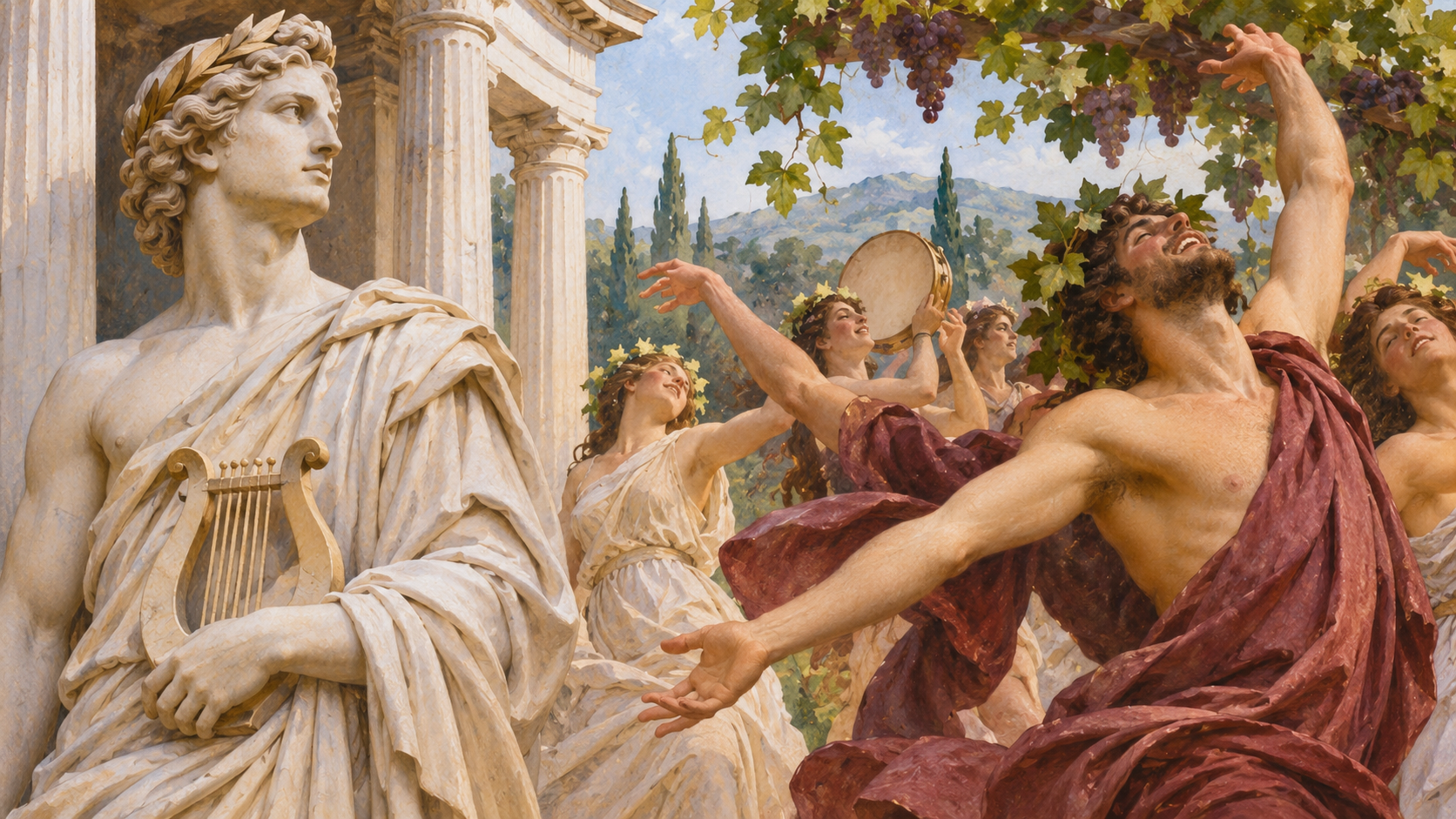
Apollonian: Associated with Apollo, dreams, images, proportion, distinct forms, and the individual self. It gives shape and intelligibility to experience.
Dionysian: Associated with Dionysus, music, intoxication, ecstatic collective experience, and the loosening of individual boundaries. It confronts the unsettling energies of existence.
Tragic synthesis: Nietzsche argues that Attic tragedy joins these impulses. Its dramatic images and characters give form to an experience of suffering and vitality that cannot be fully contained by rational explanation.
Socratic optimism: Nietzsche criticizes the confidence that reason and knowledge can explain and correct existence. He associates this tendency with Socrates and, controversially, with Euripides’s transformation of tragedy.
Learning Objectives
By the end of the unit, students should be able to:
- Explain the Apollonian and Dionysian as artistic drives rather than simple labels for “good” and “bad.”
- Describe why Nietzsche regards Greek tragedy as an artistic response to suffering.
- Analyze his account of Socrates and Euripides and distinguish interpretation from historical evidence.
- Evaluate how Nietzsche connects ancient art to nineteenth-century music and culture.
Suggested Four-Session Sequence
Session 1 — Greek Culture and the Two Artistic Drives
Introduce Nietzsche’s challenge to an idealized view of Greece. Have students identify the qualities he assigns to Apollo and Dionysus.
Session 2 — The Emergence of Tragedy
Explore the relationship between chorus, music, dramatic image, and tragic hero. Ask how form and ecstatic experience work together.
Session 3 — Socrates, Euripides, and the Decline of Tragedy
Reconstruct Nietzsche’s argument and test its assumptions against a Greek play students have read.
Session 4 — Modern Art and Critical Response
Discuss Nietzsche’s hopes for a revival of tragic art and the limits of applying his framework to later works.
Passages and Problems for Close Reading
Opening sections (especially §§1–4): What does Nietzsche mean by dream and intoxication? Why are both necessary to art?
Discussion of tragedy and the chorus (especially §§7–8): What work does music do that dialogue or visual representation cannot?
Discussion of Euripides and Socrates (especially §§11–15): Does Nietzsche demonstrate a historical change, or impose a philosophical pattern on it?
Later sections on modern culture and music (especially §§16–25): Where does argument become cultural advocacy?
Discussion Questions
- Can art make suffering meaningful without claiming that suffering is good?
- Are the Apollonian and Dionysian opposites, complements, or both?
- How fairly does Nietzsche characterize Euripides and Socrates?
- What is gained—and lost—when an account of Greek tragedy is used to criticize modern life?
Classroom Activities and Assessment
Concept comparison: In small groups, choose a scene from a Greek tragedy and identify moments of form, order, music, collective emotion, and disruption. Explain where Nietzsche’s categories illuminate the scene and where they fail.
Argument audit: Students select a claim about Socrates or Euripides, distinguish Nietzsche’s evidence from his judgment, and write a short counterargument.
Short essay: “For Nietzsche, tragedy does not eliminate suffering; it transforms our relation to it.” Evaluate this proposition with references to The Birth of Tragedy and one ancient play.
Teaching Considerations
Avoid presenting Nietzsche’s interpretation as a settled history of Greek drama. His account of Euripides, Socrates, and the tragic chorus remains influential but disputed. The book also uses sweeping cultural judgments; invite students to examine its rhetoric as well as its ideas.
Section numbers are more reliable than page numbers across editions; verify quotations against Ian Johnston’s Richer Resources Publications translation.
Concluding Perspective
The Birth of Tragedy asks whether art is merely an ornament of life or a way of confronting its most difficult truths. Its lasting classroom value lies in the productive tension between its imaginative insights and its contestable claims.
A printable PDF version of this resource is available by email.