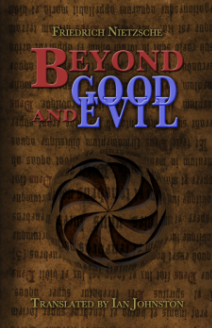
Introduction: Teaching Nietzsche’s Challenge
Published in 1886, Beyond Good and Evil: Prelude to a Philosophy of the Future questions the assumptions behind inherited philosophical systems and moral judgments. Nietzsche’s numbered aphorisms invite readers to examine not only what philosophers claim but why they are drawn to particular claims. The aim of this guide is to help students reconstruct his arguments, test his provocations, and respond critically rather than treating every sentence as a settled doctrine.
Historical and Intellectual Context
Friedrich Nietzsche (1844–1900) wrote against the background of nineteenth-century European philosophy, Christian morality, scientific confidence, and democratic ideals. He had trained in classical philology, but this mature work reaches beyond antiquity. It is arranged in nine parts, followed by an epode; its aphoristic structure demands attention to changes in voice, irony, and context.
Key Ideas for Teaching
Truth and perspective. Nietzsche asks whether a philosopher’s supposed pursuit of objective truth may conceal personal commitments, instincts, or prejudices. This does not make every interpretation equally persuasive.
The critique of morality. He challenges the assumption that familiar moral values are universal or self-evident, asking about their origins and the kinds of life they encourage.
Will to power. Nietzsche explores striving, interpretation, and the exercise of power as forces in life; avoid presenting this complex concept as a simple demand for political domination.
Free spirits and philosophers of the future. He imagines thinkers capable of questioning received values and taking responsibility for new evaluations.
Psychology and masks. Nietzsche treats philosophers’ arguments as revealing their temperaments and desires, while his own writing frequently adopts shifting poses.
Learning Objectives
Students should be able to identify an assumption Nietzsche challenges; explain how his aphoristic style shapes interpretation; distinguish a psychological explanation of a belief from an argument against its truth; evaluate his critique of conventional morality; and support their own readings with numbered sections.
Suggested Four-Session Sequence
Session 1 — Philosophers and their prejudices: Read the Preface and selections from Part One. Ask what Nietzsche believes philosophers take for granted.
Session 2 — Free spirits and truth: Explore Part Two and discuss whether independence from inherited beliefs guarantees better judgment.
Session 3 — Morality and its history: Use selections from Parts Five and Seven to examine the assumptions behind moral judgments and Nietzsche’s rhetorical methods.
Session 4 — The philosopher of the future: Discuss Parts Six and Nine, comparing Nietzsche’s ideal of intellectual independence with students’ objections to elitism and exclusion.
Close-Reading Suggestions
Preface and §§1–6: Why does Nietzsche question the “will to truth”? What does he suggest about philosophers’ motives?
§§34 and 43: How does he complicate simple oppositions such as truth/error and good/evil?
§§186–188: How does Nietzsche challenge moral philosophy and discuss discipline or constraint?
§§211–212: What distinguishes Nietzsche’s philosopher of the future from a scholar or critic?
§260: How does Nietzsche contrast master and slave moralities, and what problems arise in applying the distinction?
Discussion Questions
- Does discovering a motive behind a belief prove that the belief is false?
- How can readers separate Nietzsche’s serious arguments from irony and provocation?
- Is going “beyond good and evil” the same as rejecting every ethical responsibility?
- What might be gained—and lost—by replacing inherited values with new evaluations?
- How do Nietzsche’s criticisms of equality and democracy complicate his appeal to independent thought?
Classroom Activities and Assessment
Aphorism workshop: Assign small groups a numbered section. Have them paraphrase its claim, identify an assumption, and develop a charitable objection.
Argument versus rhetoric: Students mark where Nietzsche offers reasons, examples, metaphors, or insults. Discuss the effect of each.
Short essay: “Nietzsche’s critique of philosophers is as much psychological as logical.” Evaluate with evidence from at least two numbered sections.
Teaching Considerations
Nietzsche’s remarks about gender, hierarchy, nations, and social groups can be offensive and should be examined directly rather than excused or silently omitted. Encourage evidence-based disagreement and distinguish the historical context of a claim from its justification.
Avoid reducing his views to slogans such as “anything goes” or treating the will to power as a single settled theory. Section numbers, rather than page numbers, are best for classroom assignments across editions. Check any direct quotations against Ian Johnston’s translation.
Concluding Perspective
Beyond Good and Evil asks readers to interrogate the values and assumptions that make their judgments seem obvious. Its strongest educational use is not to secure agreement with Nietzsche, but to sharpen students’ ability to interpret difficult arguments, question premises, and defend their own conclusions.
A printable PDF version of this resource is available by email.