Reading Nietzsche: Why Does Tragedy Matter?
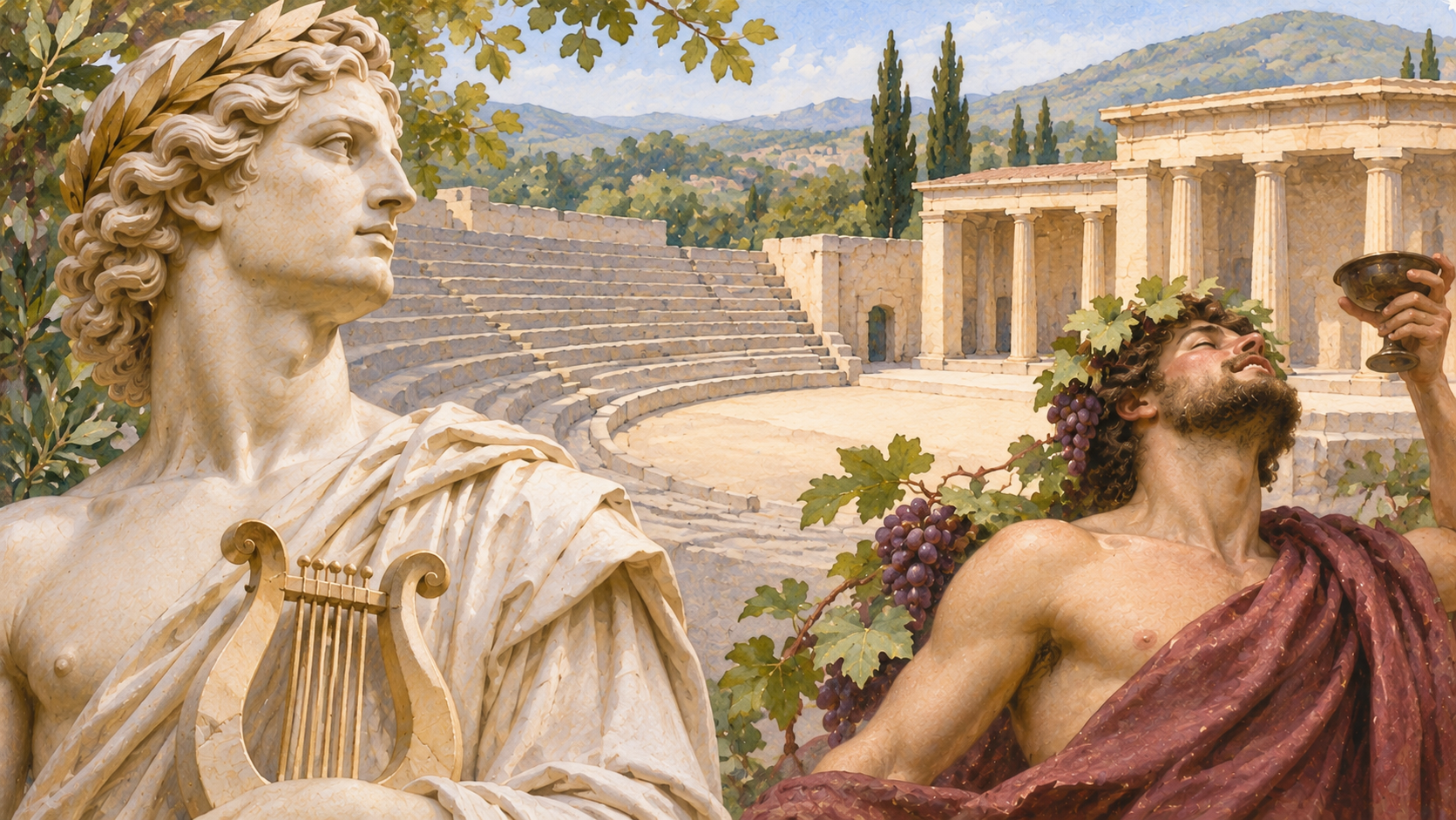
Why would people choose to watch a story filled with suffering? In The Birth of Tragedy (1872), Friedrich Nietzsche argues that ancient Greek tragedy did more than entertain. It helped people confront the painful and unpredictable aspects of existence through art. His explanation centers on two contrasting artistic forces: the Apollonian and the Dionysian.
Meet Nietzsche
Friedrich Nietzsche (1844–1900) was a German philosopher trained in ancient Greek language and literature. He wrote The Birth of Tragedy early in his career. The book blends his interpretation of Greek drama with ideas about music and the culture of his own time.
His account is influential but disputed. Read it as an argument to examine, not a settled history of theater.
Two Artistic Forces
The Apollonian: Named for Apollo, associated with light and dreams. It represents clear images, proportion, boundaries, individual identity, and the beautiful forms through which art gives shape to experience.
The Dionysian: Named for Dionysus, associated with music, intoxication, and collective celebration. It represents intense emotion and experiences in which ordinary individual boundaries seem to dissolve.
Nietzsche believes tragedy brings these forces together. Dramatic characters and visible action give shape to powerful emotions and to the unsettling realities of life. Neither force is simply good or bad.
How Nietzsche Explains Greek Tragedy
Nietzsche emphasizes the tragic chorus and music, which he connects with Dionysian experience. The dramatic figures and stories provide an Apollonian form through which the audience can encounter that experience.
He argues that tragedy offers an artistic way of facing suffering rather than pretending it does not exist.
Socrates and Euripides
Nietzsche argues that an increasing faith in rational explanation changed Greek tragedy. He associates this change with the philosopher Socrates and the playwright Euripides.
Ask whether he gives convincing evidence for this interpretation. His criticism of these figures is a philosophical judgment, not an undisputed historical fact.
Reading Questions
- How do the Apollonian and Dionysian differ? Can you find an example of each in a play, song, or film?
- Why might an audience find value in a tragic story rather than a happy one?
- What role does Nietzsche assign to music and the chorus?
- Why does Nietzsche criticize Socrates and Euripides? What might a defender of either say?
- Is Nietzsche describing ancient Greek drama, arguing for a theory of art, or doing both?
Try It Yourself
Compare two scenes: Choose a scene from a Greek tragedy. Identify moments of order, visual form, intense feeling, or collective experience. Explain whether Nietzsche’s categories help you understand the scene.
Test a claim: Select one of Nietzsche’s claims about tragedy. Write a short paragraph explaining the claim, one reason supporting it, and one objection.
Create a dialogue: Write a brief exchange between someone who thinks art should explain life rationally and someone who thinks art should help us experience its mysteries.
A Final Thought
Nietzsche asks us to consider whether art is a distraction from life's difficulties or one of the ways we face them. You do not need to accept his answer. A strong reading identifies his ideas, examines his evidence, and develops your own response.
A printable PDF version of this resource is available by email.