From Companions to Rulers: Character and Power in Birds
Characters in a World Turned Upside Down
In Aristophanes’ Birds, character is revealed through argument, comic confrontation, and changing relationships. Two Athenians set out in search of a better life, but their journey produces an extraordinary political experiment. As Cloudcuckooland rises, the relationships among human beings, birds, and gods are transformed.
The central question is not simply who succeeds, but who gains authority—and whose interests that authority serves.
Pisthetairos: The Persuasive Architect of Power
Pisthetairos is the driving force of the comedy. Dissatisfied with Athenian life, he persuades the birds to establish a city between earth and heaven. His ingenuity makes the impossible seem practical.
He is also an increasingly commanding figure. He dismisses unwelcome visitors, challenges divine authority, and negotiates a settlement favorable to himself.
Key relationship: Pisthetairos begins as an outsider seeking the birds’ assistance. By the end, he has become the dominant figure in the world they have helped create.
Question: Is his success a triumph of intelligence, or a warning about the persuasive leader who gathers power?
Euelpides: The Companion Who Recedes
Euelpides accompanies Pisthetairos in their flight from Athens. Their exchanges establish the comic tone and make their initial desire for peace understandable.
Although both men begin the adventure together, Euelpides becomes less central as Pisthetairos takes control. This difference helps expose the movement from shared dissatisfaction to individual ambition.
Key relationship: Their companionship provides a measure of how far Pisthetairos’ original purpose changes.
Question: Why might Aristophanes allow one traveler to dominate the action while the other fades from view?
Tereus, the Hoopoe: The Bridge Between Worlds
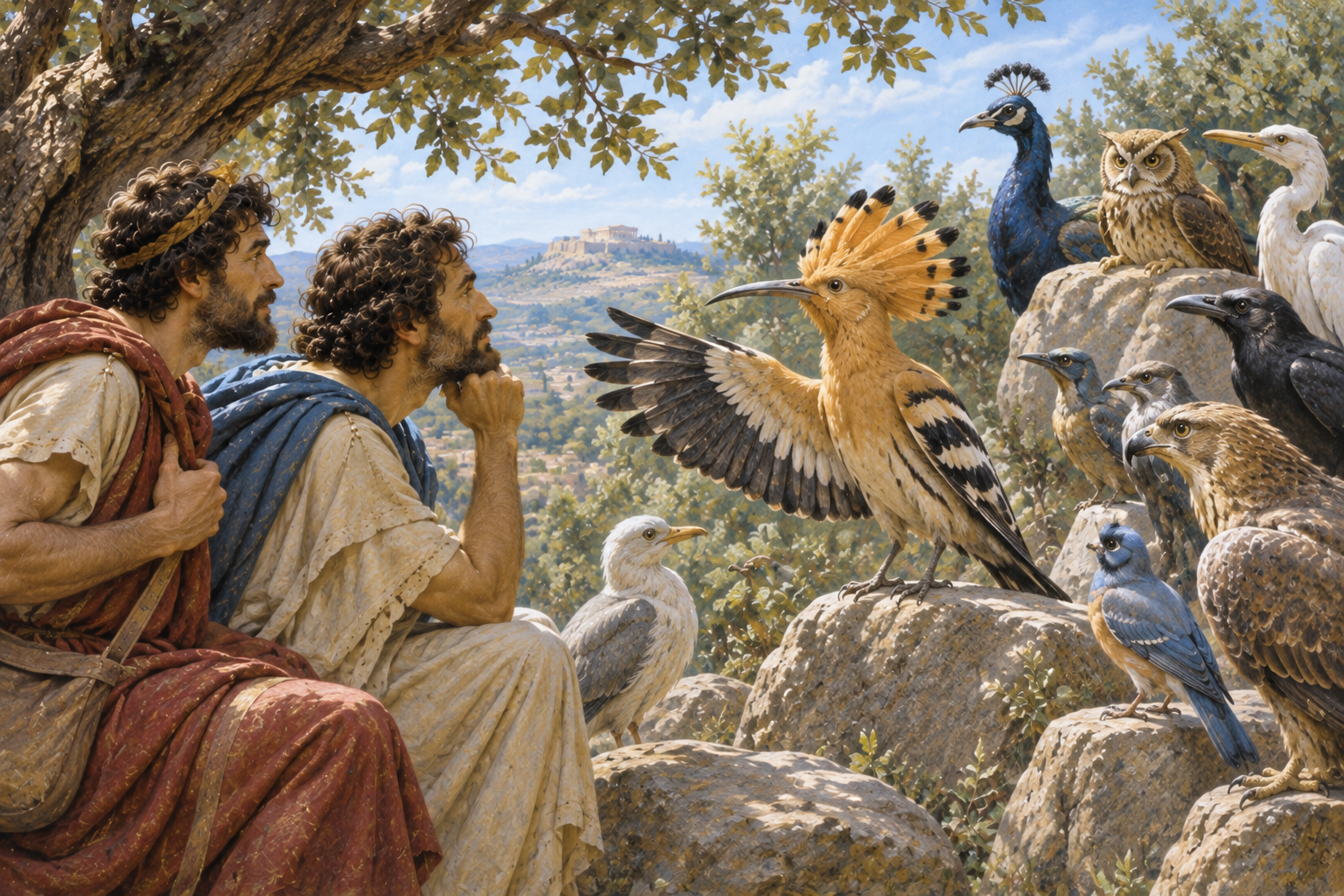
Tereus was once a human king but has been transformed into a bird. His unusual position makes him a natural intermediary between the Athenians and the avian community.
He introduces the visitors to the birds, helping turn a strange encounter into a political alliance. Yet he does not become the chief architect of the new city.
Key relationship: The Hoopoe makes Pisthetairos’ scheme possible by connecting the newcomers with the birds.
Question: How does the Hoopoe’s history as a human king complicate the distinction between human and bird society?
The Chorus of Birds: A Community with Its Own Voice
The bird chorus initially treats the human visitors as enemies. Through Pisthetairos’ arguments, the birds come to embrace the idea of recovering their supposed ancient supremacy.
Their songs celebrate freedom, flight, and the natural world. Their collective enthusiasm gives the new city its energy and legitimacy.
Key relationship: The birds are both partners in Pisthetairos’ plan and the community over which he increasingly exercises influence.
Question: Do the birds gain the independence they were promised?
The Gods: Authority Under Challenge
The gods initially occupy a position of unquestioned superiority. Cloudcuckooland changes that balance by interrupting the passage of sacrifices from human beings to Olympus.
Iris appears as a divine messenger and is challenged by Pisthetairos. Prometheus secretly advises him, while Poseidon, Heracles, and the Triballian god arrive as negotiators.
Their differences create comedy: even the gods are vulnerable to appetite, disagreement, and manipulation.
Key relationship: Pisthetairos changes from a mortal subject of divine power into a negotiator who can impose terms upon the gods.
The Visitors: Familiar Athens in an Imaginary City
The poet, prophet, surveyor, official, and other visitors bring recognizable social ambitions into the fantastic setting. Some seek patronage; others try to establish authority or obtain benefits.
Their encounters with Pisthetairos expose the difficulty of escaping the habits and institutions of the society the travelers abandoned.
Key relationship: The visitors test Pisthetairos’ control over his new political creation.
A Relationship Map
- Pisthetairos and Euelpides: Companions whose roles become unequal.
- Pisthetairos and the Hoopoe: Outsider and intermediary, joined by an imaginative proposal.
- Pisthetairos and the birds: Persuader and persuaded community, eventually leader and followers.
- The birds and the gods: Rival claimants to supremacy.
- Pisthetairos and the gods: Mortal challenger and displaced authorities.
- Pisthetairos and the visitors: Founder and outsiders seeking influence or advantage.
Questions for Reading and Discussion
- Which character changes most over the course of the play?
- How does Pisthetairos persuade others to accept his proposals?
- What does Euelpides’ reduced importance reveal about the direction of the action?
- Are the birds active participants in their new society or primarily followers?
- How does Aristophanes make the gods resemble human political figures?
- Which relationships best reveal the play’s satire of ambition and authority?
Classroom Activity: Who Holds the Power?
Ask students to select four moments from the play: the arrival of the Athenians, the persuasion of the birds, the encounters with visitors, and the negotiations with the gods.
For each moment, identify who appears to hold power, how that power is exercised, and who benefits. Students can then discuss whether the play presents Cloudcuckooland as a successful community or the achievement of one unusually persuasive individual.
Note to the Educator
Encourage students to examine what characters do and say rather than treating each as a fixed political symbol. The play invites competing interpretations: Pisthetairos can be admired for his inventiveness while also questioned for his growing appetite for control.
Reading the Play
A printable PDF version of this resource is available by email.