An Ideal World—or Another Struggle for Power?
The Promise and Paradox of Cloudcuckooland
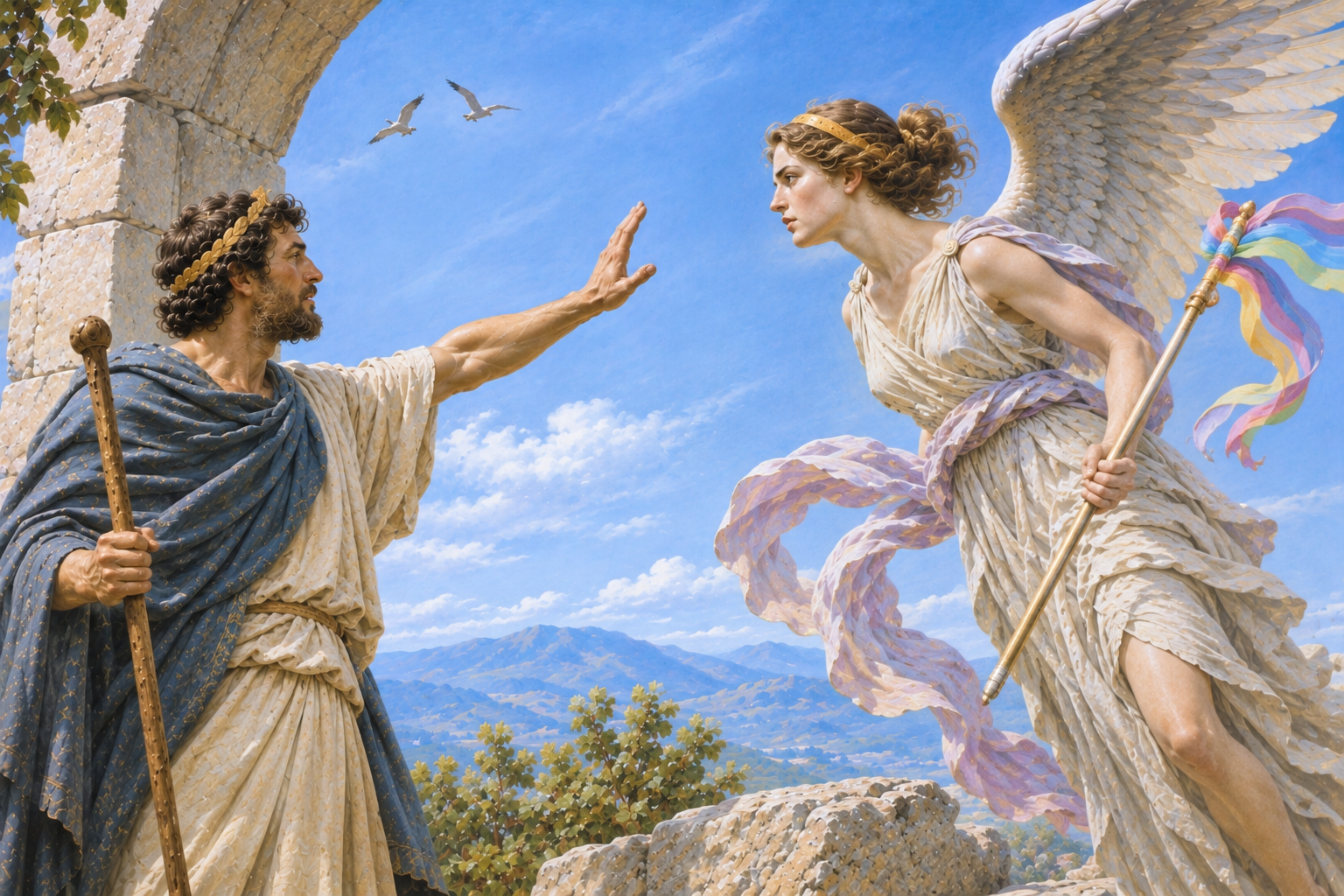
Aristophanes’ Birds begins with an appealing wish: to escape the noise, lawsuits, and obligations of Athens and discover a better way of living. Yet the imagined refuge becomes a powerful new state. Through fantasy, satire, and extravagant comedy, Aristophanes invites audiences to consider whether people can escape the political habits they hope to leave behind.
1. Utopia and the Search for Freedom
Pisthetairos and Euelpides seek a place free from the frustrations of Athenian civic life. The birds seem to offer an alternative: creatures that fly freely above human boundaries and disputes.
But the proposed city in the sky develops walls, rules, and claims to authority. What begins as a dream of freedom becomes a project of control.
Consider: Does Cloudcuckooland fulfill the travelers’ original hopes, or contradict them?
2. Ambition and the Desire for Power
Pisthetairos proposes that the birds reclaim their ancient importance and control the space between humans and gods. His plan promises greatness to the birds, but he increasingly directs events himself.
By the end, he negotiates with the gods and marries Sovereignty. His personal rise raises questions about the difference between leadership and domination.
Consider: Is Pisthetairos a brilliant liberator, an opportunist, or both?
3. Persuasion and Political Leadership
The new city begins not with force but with a speech. Pisthetairos persuades the birds that they once possessed authority greater than that of the Olympian gods.
His arguments are inventive and entertaining, yet their effectiveness does not necessarily make them true. The play exposes the power of rhetoric to turn dissatisfaction into collective action.
Consider: How can an audience distinguish a persuasive argument from a trustworthy one?
4. Human Nature and the Failure to Escape Society
The visitors to Cloudcuckooland bring familiar human ambitions with them: requests for rewards, official positions, influence, and special treatment.
These episodes suggest that founding a new society does not automatically eliminate the habits of the old one. Even in a fantastic world, self-interest and rivalry remain.
Consider: Is the problem Athens itself, or the behavior of the people who inhabit it?
5. The Natural World and the Human Imagination
The Chorus of Birds celebrates flight, seasonal rhythms, song, and the pleasures of life beyond human institutions. These passages give the play an imaginative richness that exceeds its political satire.
Yet the birds’ freedom is also drawn into Pisthetairos’ plans for walls, territory, and supremacy.
Consider: Does the play celebrate nature as an alternative to politics, or show how easily nature can be appropriated for political purposes?
6. Gods, Religion, and Reversed Authority
The birds’ city interrupts the sacrifices rising from humans to Olympus. The gods, normally imagined as superior to mortals, must negotiate with Pisthetairos.
Aristophanes makes divine figures vulnerable to hunger, disagreement, and manipulation. This comic reversal challenges assumptions about authority without requiring a single, straightforward religious message.
Consider: What makes the gods funny when they behave like human politicians?
7. The Ambiguity of Comic Victory
The play ends in celebration. Pisthetairos has achieved extraordinary success, but his triumph is far removed from the modest search for peace that began the adventure.
The audience can enjoy the exuberant ending while questioning what has actually been gained—and by whom.
Consider: Does a comic ending have to represent a morally desirable outcome?
Questions for Reading and Discussion
- Which scenes most clearly show the difference between freedom and power?
- How does Pisthetairos use the birds’ dissatisfaction to win their support?
- Why is the contrast between the birds’ songs and the new city's political ambitions important?
- What do the visiting human characters reveal about the possibility of creating an ideal society?
- How does the reversal of human and divine authority contribute to the satire?
- Is the play's final celebration sincere, ironic, or deliberately open to both readings?
Classroom Activity: Design a Better City
Divide students into small groups and ask each to establish three principles for an ideal community. Groups should then consider who would enforce those principles, how disputes would be settled, and what would prevent leaders from accumulating excessive power.
Compare their decisions with the development of Cloudcuckooland. Discuss how quickly an ideal society can acquire the institutions and conflicts it was meant to escape.
Note to the Educator
Birds was first performed in 414 BCE during the Peloponnesian War. Its historical setting enriches discussions of empire and Athenian politics, but the play should not be treated as a simple allegory with a fixed meaning. Encourage students to support interpretations with particular speeches, scenes, and comic reversals.
Reading the Play
A printable PDF version of this resource is available by email.