Fathers, Sons, and the Art of Winning Arguments
A Comedy of Conflicting Ambitions
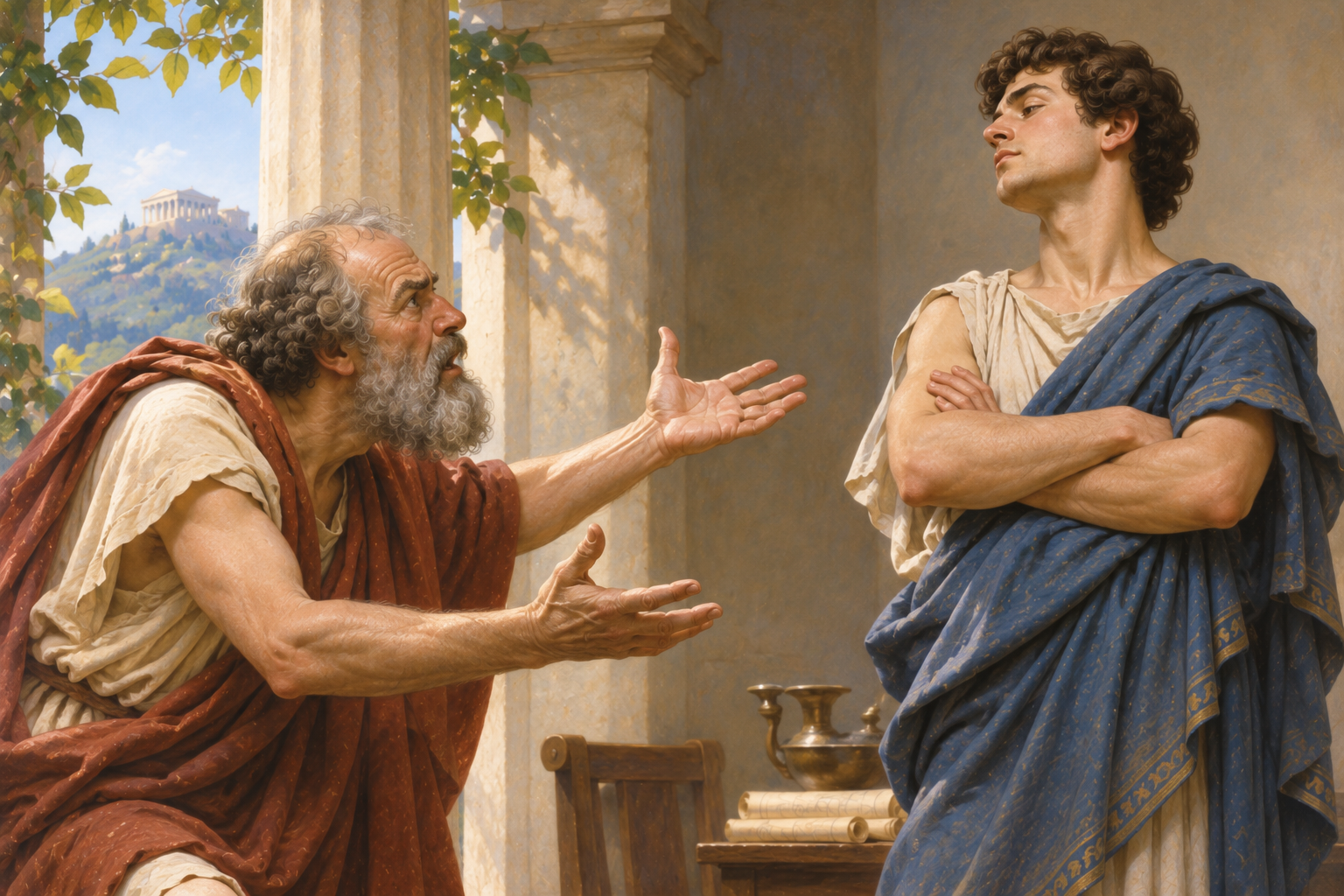
In Aristophanes’ Clouds, the characters are united by a question: what is education for? Strepsiades wants to escape his debts, Pheidippides prefers his expensive habits, and the comic Socrates offers a school where conventional beliefs are questioned and verbal ingenuity is cultivated.
Their relationships turn an apparently practical problem—how to avoid paying creditors—into a conflict over family loyalty, moral responsibility, and the uses of intelligence.
Strepsiades — The Desperate Father
Strepsiades is an older Athenian burdened by debts arising largely from his son's enthusiasm for horses and expensive living. He is resourceful, anxious, and often ridiculous.
He approaches the Thinkery not because he loves knowledge but because he hopes to learn arguments that will defeat his creditors. His attempts at study expose his limited understanding and his willingness to use cleverness for dishonest ends.
Central conflict: Strepsiades wants the benefits of education without accepting responsibility for the way he intends to use it.
Pheidippides — The Son Who Learns Too Well
Pheidippides is devoted to horses and the fashionable pursuits that have helped ruin his father's finances. Initially reluctant to attend the Thinkery, he eventually becomes skilled in argument.
His education produces the play's sharpest reversal. When he uses reasoning to justify striking his father, Strepsiades discovers that the methods he hoped to exploit can also be turned against him.
Central conflict: Pheidippides' verbal skill raises the question of whether winning an argument is the same as being right.
Socrates — The Comic Intellectual
Aristophanes presents Socrates as the head of the Thinkery, a school associated with unusual investigations into nature, language, and argument.
This is a theatrical caricature, not a reliable portrait of the historical philosopher. The comic Socrates combines characteristics associated with several intellectual movements in fifth-century Athens.
He represents a kind of education that Strepsiades both admires and misunderstands. His apparent authority is repeatedly undermined by the absurdity of the school's activities.
Central conflict: The Thinkery's pursuit of intellectual ingenuity is placed beside Strepsiades' desire for practical dishonesty.
The Better and Worse Arguments — Education in Debate
The Better Argument and the Worse Argument are personified positions in a formal contest.
The Better Argument praises traditional discipline, modesty, physical training, and respect for established customs. The Worse Argument uses verbal cleverness to challenge those ideals and defend behavior that traditional morality condemns.
Their contest dramatizes a struggle between older and newer approaches to education. Yet Aristophanes also invites laughter at the rigid nostalgia of the Better Argument.
Central conflict: Should education cultivate character, develop the power to persuade, or somehow accomplish both?
The Chorus of Clouds — Shifting Perspectives
The Clouds are the play's chorus and are associated with the comic Socrates' unconventional account of the world.
Their changing forms suit a comedy concerned with unstable appearances and flexible arguments. They also comment upon the action and eventually emphasize the consequences of Strepsiades' choices.
The Clouds should not be treated simply as allies of Strepsiades or Socrates. Their role is more complicated, combining spectacle, humor, and judgment.
Supporting Characters
The Student of Socrates: Introduces Strepsiades to the Thinkery and its strange investigations.
The Creditors: Represent the financial obligations Strepsiades hopes to evade. Their demands bring his scheme into direct conflict with ordinary civic responsibilities.
Strepsiades' Wife: Although she does not appear as an active speaking character, Strepsiades' account of their marriage helps explain the family's differences in social expectations and spending.
Relationships That Drive the Comedy
Strepsiades and Pheidippides
The father attempts to control his son's behavior and then his education. The son eventually acquires the argumentative power to challenge paternal authority itself.
Question: How does the ending reverse their relationship at the beginning?
Strepsiades and Socrates
Strepsiades sees Socrates as someone who can solve his financial problems. Socrates, meanwhile, is frustrated by Strepsiades' inability to follow his instruction.
Question: Does Strepsiades misunderstand the Thinkery, or does the Thinkery invite misuse?
Pheidippides and the Two Arguments
The contest between Better and Worse Argument prepares the audience for Pheidippides' later use of reasoning against his father.
Question: What does Pheidippides learn about the relationship between persuasion and moral responsibility?
Strepsiades and the Clouds
Strepsiades initially treats the Clouds as powerful sources of assistance. By the end, their role becomes connected with his recognition of his own wrongdoing.
Question: How does his understanding of the Clouds change?
Classroom Activity: A Map of Changing Authority
Ask students to draw a relationship map placing Strepsiades at the center. Connect him to Pheidippides, Socrates, the Clouds, and the creditors.
For each connection, identify:
- What Strepsiades wants from the other character.
- Who holds power at the beginning.
- How the relationship changes.
- What the change reveals about education, responsibility, or authority.
Students should then explain which relationship is most important to the play's conclusion.
Note to the Educator
Distinguish Aristophanes' comic portrayal of Socrates from the historical philosopher. The play can illuminate Athenian anxieties about intellectual fashions without serving as a factual account of Socrates' teaching. Encourage students to consider the shortcomings of both traditional and fashionable education rather than treating the comedy as a simple argument for one side.
Reading the Play
This resource may be used alongside Ian Johnston's translation of Aristophanes' Clouds, available from Richer Resources Publications.
A printable PDF version of this resource is available by email.