Athens in an Age of New Ideas
The World Behind the Comedy
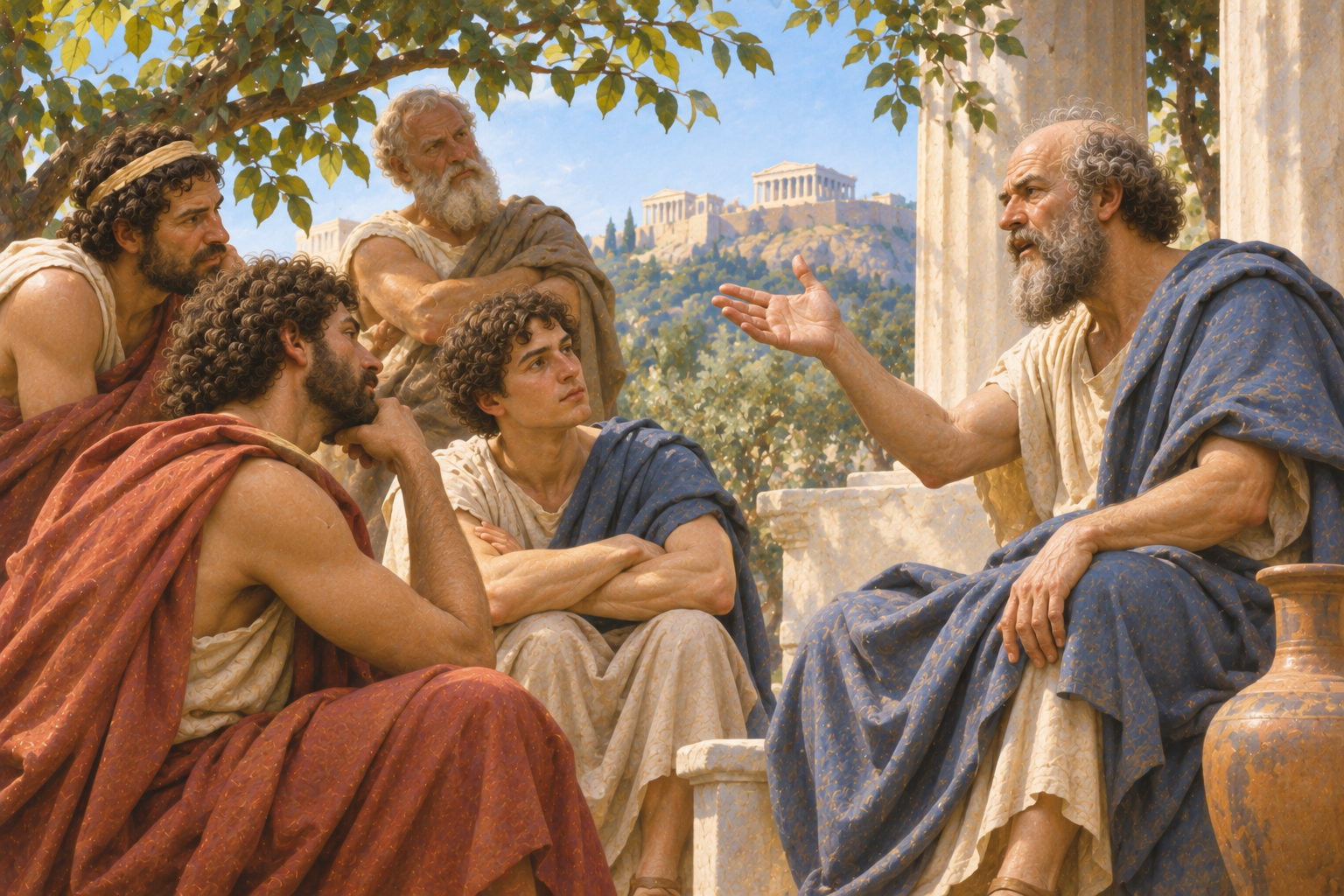
When Aristophanes’ Clouds was first performed in 423 BCE, Athens was experiencing political conflict, military uncertainty, and vigorous intellectual debate. Traditional beliefs about religion, education, and authority were increasingly being questioned by teachers and thinkers who offered new ways of explaining the world and persuading other people.
Clouds turns these developments into comedy. Its fictional Thinkery brings together several intellectual trends, while its portrayal of Socrates exaggerates them for theatrical effect.
Understanding this background helps students recognize the play as both a humorous story and a response to the changing culture of classical Athens.
1. Athens During the Peloponnesian War
The original production of Clouds took place during the Peloponnesian War, the prolonged conflict between Athens and Sparta and their respective allies.
Athens remained a center of public debate, artistic competition, and intellectual activity, even as warfare created anxiety and political tensions.
Aristophanes wrote for audiences familiar with these pressures. His comedy reflects a city in which established values and new ideas competed for influence.
For discussion: Why might an audience living through political and military uncertainty be especially sensitive to changes in education and public morality?
2. Democracy and the Importance of Persuasive Speech
In democratic Athens, citizens could participate in the Assembly and serve in the courts. Public speaking therefore had considerable practical importance.
The ability to construct and present an effective argument could influence political decisions, legal disputes, and personal reputation.
This environment encouraged interest in rhetoric—the art of persuasive speech.
In Clouds, however, Strepsiades wants persuasive skill for a questionable purpose: avoiding his debts. Aristophanes turns a valued civic ability into a source of comic danger.
For discussion: Why might the ability to persuade be both valuable and potentially dangerous in a democracy?
3. The Sophists and New Approaches to Education
The Sophists were teachers and intellectuals associated with instruction in argument, language, and subjects useful in public life. Some traveled between cities and charged fees for their teaching.
They did not all share one philosophy. Nevertheless, their emphasis on education and argument challenged older assumptions about how young men should prepare for adult responsibilities.
The contest between Better Argument and Worse Argument dramatizes anxieties about these developments.
Better Argument praises traditional discipline and modesty. Worse Argument demonstrates the power of reasoning that challenges established standards.
The debate is deliberately exaggerated. It should not be read as an impartial description of actual Sophistic teaching.
4. Natural Philosophy and Explanations of the World
Greek thinkers had long investigated the natural world, asking questions about the heavens, weather, matter, and the causes of physical events.
Some explanations differed sharply from traditional religious accounts.
In Clouds, Socrates discusses natural phenomena and introduces the Clouds as powerful figures associated with his unusual teachings.
The comedy makes intellectual investigation seem both fascinating and absurd. Its jokes depend partly on the contrast between complicated explanations and ordinary experience.
For discussion: Does the play make fun of asking questions about nature, or of the way certain thinkers present their answers?
5. Socrates: Historical Figure and Comic Character
Socrates was a real Athenian philosopher, born around 469 BCE. He became known for questioning others about knowledge, virtue, and the meaning of important ideas.
Aristophanes’ Socrates is not a reliable historical portrait.
The comic character combines features associated with natural philosophers, Sophistic teachers, and public stereotypes about intellectuals. He presides over a school that promises unusual forms of knowledge and appears in the famous scene suspended in a basket.
The historical Socrates left no writings of his own. Much of what is known about him comes from other authors, especially Plato and Xenophon, whose accounts also require interpretation.
Clouds is valuable evidence of how an Athenian audience could be invited to laugh at Socrates, but it does not establish that he actually taught the practices attributed to him in the play.
6. Traditional Education and Generational Conflict
Traditional Athenian education for boys from families able to provide it emphasized such subjects as music, poetry, physical training, and socially approved conduct.
New forms of intellectual instruction raised questions about whether established customs should continue to govern behavior.
Aristophanes presents this tension through Strepsiades and Pheidippides. The father wants the advantages of new education without accepting the challenges it might pose to traditional authority.
The resulting conflict reveals an important contradiction: Strepsiades welcomes unconventional reasoning when it serves his interests but rejects it when his son uses it against him.
7. Religion, Skepticism, and Satire
The play also draws humor from disputes about divine authority and explanations of natural events.
The comic Socrates challenges familiar religious assumptions, while Strepsiades struggles to understand what he is being taught.
These scenes reflect anxieties about religious and intellectual change, but they do not provide a simple account of what Athenians believed. Nor should the comedy be treated as proof that Socrates personally rejected every traditional belief attributed to his stage character.
Aristophanes uses exaggeration to provoke laughter and questions rather than to offer a balanced philosophical history.
8. Old Comedy and the Athenian Festival
Clouds belongs to Old Comedy, a form of Athenian drama known for bold satire, fantastic situations, political commentary, choral performance, and direct engagement with the audience.
The play was originally produced at the City Dionysia in 423 BCE, where it placed third in the comic competition.
The surviving text reflects a later revision, so it should not be assumed to reproduce the original performance exactly.
This distinction matters when studying its dramatic structure, particularly the chorus and passages in which the poet addresses the audience.
Classroom Activity: Satire Versus Historical Evidence
Ask students to compare three kinds of statements:
- Aristophanes portrays Socrates as the head of the Thinkery.
- Some fifth-century Greek thinkers investigated natural phenomena and taught techniques of argument.
- Socrates personally taught students to evade debts through dishonest arguments.
Have students classify each statement as a fact about the play, a historically supportable generalization, or a claim requiring evidence that the comedy does not provide.
Then discuss why a playwright might combine recognizable people, genuine intellectual developments, and deliberate exaggeration.
Extension: Ask students to identify a modern example of satire that combines a real public figure with invented behavior. How should historians treat such a portrayal?
Note to the Educator
The most important historical distinction in teaching Clouds is between Aristophanes’ theatrical Socrates and the historical philosopher.
Avoid treating the Sophists as a single unified school or assuming that every new intellectual movement rejected traditional morality. The play reflects contemporary debates through caricature, exaggeration, and comic reversal.
Students will gain a richer understanding by asking what the comedy reveals about Athenian anxieties, rather than accepting every stage portrayal as historical fact.
Reading the Play
This resource may be used alongside Ian Johnston’s translation of Aristophanes’ Clouds, available from Richer Resources Publications.
A printable PDF version of this resource is available by email.