From Clever Schemes to Comic Catastrophe
How the Comedy Unfolds
Aristophanes’ Clouds begins with a familiar problem: an anxious father cannot pay his debts. Its plot develops through a series of increasingly absurd attempts to escape responsibility, culminating in the destruction of the very school Strepsiades believed would save him.
The comedy's structure is especially important. Each apparent solution creates a greater problem, and the knowledge Strepsiades hopes to exploit eventually turns against him.
1. The Opening: A Household in Trouble
The play begins at night, with Strepsiades unable to sleep because of his debts. His son, Pheidippides, remains absorbed in dreams of horses and racing.
Strepsiades explains how the family's expensive habits have created financial difficulties. He devises a plan: someone must learn the art of argument at Socrates’ Thinkery and use it to defeat the creditors.
Dramatic function: The opening establishes the central problem, introduces the father-son conflict, and reveals the questionable purpose behind Strepsiades’ interest in education.
For discussion: Why does Aristophanes begin with Strepsiades’ financial anxiety rather than with Socrates?
2. Entering the Thinkery
When Pheidippides initially refuses to study, Strepsiades decides to attend the Thinkery himself.
He encounters students engaged in unusual investigations and meets Socrates, who appears suspended in a basket. Socrates introduces him to unconventional explanations of natural phenomena and the chorus of Clouds.
Strepsiades is fascinated by the possibility of acquiring powerful knowledge, but he repeatedly struggles to understand the instruction.
Dramatic function: The Thinkery introduces a new comic world in which familiar assumptions are overturned. The contrast between Socrates’ intellectual ambitions and Strepsiades’ practical motives creates much of the humor.
For discussion: How does the audience's understanding of the Thinkery differ from Strepsiades’ expectations?
3. The Chorus and the Parabasis
The Clouds enter as a chorus, contributing music, spectacle, and commentary.
The play also includes a parabasis, a characteristic feature of Old Comedy in which the chorus addresses the audience more directly, including remarks about the playwright and theatrical competition.
These passages interrupt the ordinary progress of the story but expand the comedy's relationship with its audience.
Dramatic function: Choral performance connects the household plot with broader questions about intellectual fashion, theatrical conventions, and public judgment.
For discussion: What can the chorus accomplish that ordinary dialogue between characters cannot?
4. Strepsiades Fails as a Student
Strepsiades’ efforts at learning become increasingly ridiculous. He cannot consistently follow Socrates’ instructions, and his preoccupation with debt continually distracts him.
Eventually, Socrates dismisses him.
Strepsiades must return to his original plan and persuade Pheidippides to undertake the education instead.
Dramatic function: The first attempt at solving the problem fails. The plot now shifts toward the son, preparing the reversal that will dominate the ending.
For discussion: Why is Strepsiades’ failure necessary to the development of the comedy?
5. Better Argument Versus Worse Argument
The personified Better and Worse Arguments compete over the education of Pheidippides.
Better Argument praises traditional discipline, modesty, and respect for established customs. Worse Argument uses clever reasoning to undermine these ideals and defend conduct that conventional morality rejects.
Worse Argument wins the contest, and Pheidippides receives the education his father desires.
Dramatic function: This debate forms a central turning point. It dramatizes the conflict over education and prepares the audience for the consequences of persuasive skill without moral restraint.
For discussion: Does Aristophanes present either Argument as entirely admirable?
6. The Creditors: Apparent Success
Strepsiades begins to believe that his plan has worked. When creditors arrive seeking payment, he confronts them with evasions, mockery, and arguments influenced by his encounter with the Thinkery.
For a moment, he appears to have gained the advantage.
Dramatic function: This apparent success creates a false resolution. The audience sees Strepsiades celebrating the very behavior that will soon threaten his own authority.
For discussion: Why does Aristophanes allow Strepsiades to enjoy a temporary victory?
7. The Father-Son Reversal
The comedy reaches its most personal crisis when Pheidippides strikes his father and then argues that his behavior can be justified.
Strepsiades discovers that his son's education has produced consequences he never anticipated. The argumentative techniques he hoped would protect the family are now being used to undermine it.
Pheidippides even extends his reasoning toward the possibility of striking his mother.
Dramatic function: The central comic reversal is complete. The father who sought to escape obligations through clever speech becomes the victim of clever speech.
For discussion: Is Pheidippides’ behavior a betrayal of his father, or the logical consequence of Strepsiades’ original plan?
8. The Destructive Ending
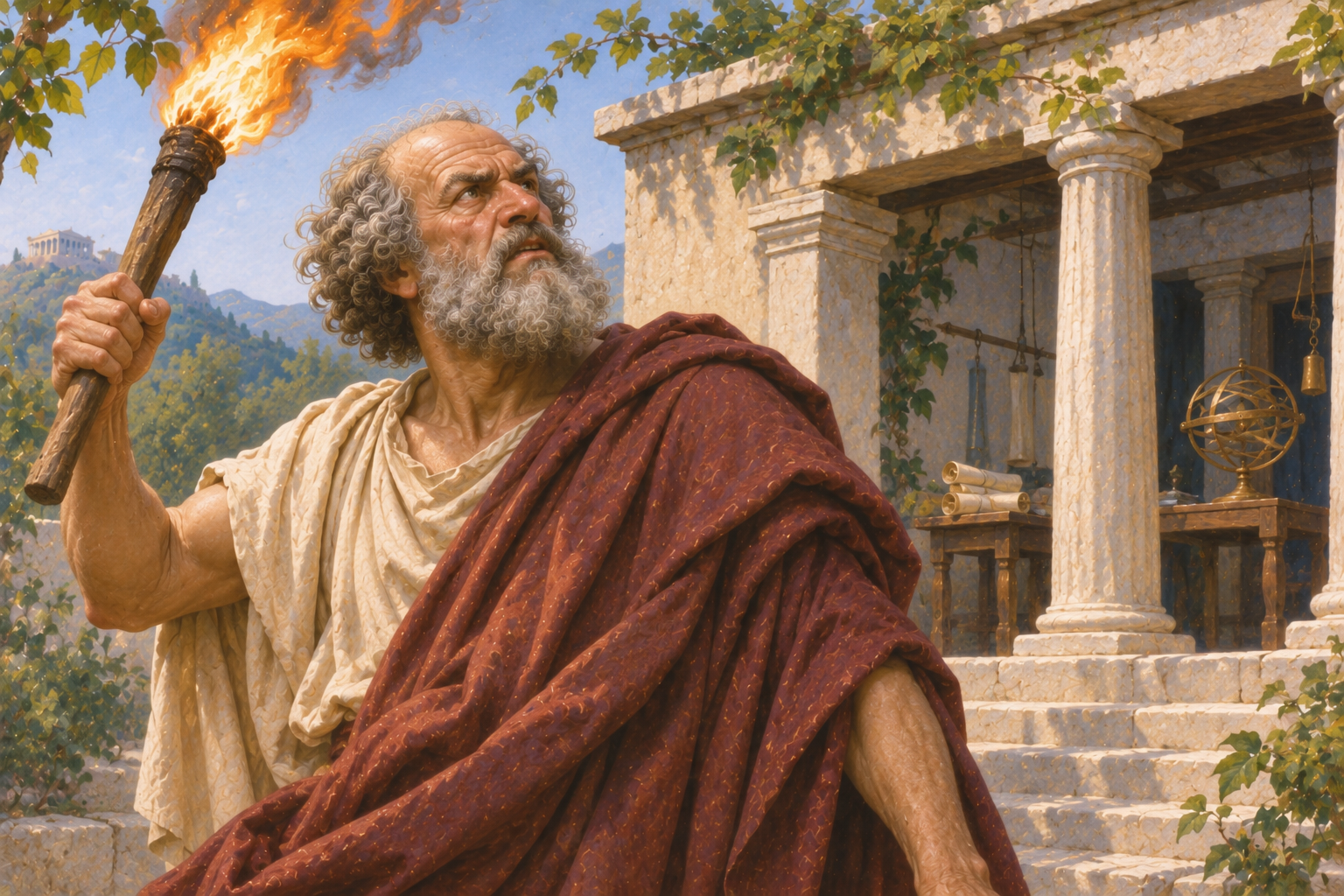
Strepsiades turns against Socrates and the Thinkery. He attacks the school, setting it on fire as those inside attempt to escape.
The ending is violent and unsettling, despite the play's comic form.
Rather than offering a harmonious resolution, Aristophanes leaves the audience confronting the consequences of foolish ambition, intellectual misuse, and anger.
Dramatic function: The final action reverses Strepsiades’ initial admiration for the Thinkery and brings the comedy to a destructive conclusion.
For discussion: Does Strepsiades learn to accept responsibility, or does he simply find someone new to blame?
The Larger Dramatic Pattern
The plot follows a clear progression:
- Problem: Strepsiades is overwhelmed by debt.
- Scheme: He seeks education as a means of avoiding payment.
- First failure: He cannot master the Thinkery's instruction.
- New strategy: Pheidippides becomes the student.
- Apparent success: Strepsiades believes he can defeat his creditors.
- Reversal: Pheidippides uses argument against his father.
- Catastrophe: Strepsiades destroys the school he once admired.
The comedy's power comes from the relationship between these stages. What begins as an attempt to avoid consequences ultimately produces more serious consequences.
Classroom Activity: Trace the Reversals
Ask students to create a three-column chart:
Strepsiades’ ExpectationWhat Actually HappensComic or Dramatic Effect
Education will eliminate his debts. | He cannot master the instruction. | Frustration and ridicule
His son will learn useful arguments. | Pheidippides learns to challenge authority. | Irony and anticipation
Clever speech will protect the household. | His son turns that speech against him. | Reversal and conflict
The Thinkery will solve his problems. | He attacks and destroys it. | Destructive conclusion
Students should identify the moment when the comedy changes from a story about financial escape into a story about the collapse of family authority.
Note to the Educator
Encourage students to examine the play as a carefully constructed comedy rather than simply a sequence of amusing episodes. Its reversals develop directly from Strepsiades’ original motives.
It is also important to distinguish Aristophanes’ fictional Socrates from the historical philosopher. The play's structure serves its comic and satirical purposes; it is not a documentary account of philosophical education.
Reading the Play
This resource may be used alongside Ian Johnston’s translation of Aristophanes’ Clouds, available from Richer Resources Publications.
A printable PDF version of this resource is available by email.