The Language and Structure of Comic Deception
Reading Aristophanes Closely
In Clouds, Aristophanes makes language itself a source of comedy. Characters argue, misunderstand, exaggerate, and manipulate words, often without recognizing the consequences of their reasoning.
The play's literary techniques do more than produce laughter. They reveal the distance between what characters believe they are accomplishing and what their actions actually achieve.
The following examples identify important techniques and suggest scenes for close analysis. Students should consult the corresponding passages in their editions, since wording and line divisions may differ between translations.
1. Dramatic Irony: The Failure the Audience Anticipates
Key scenes: Strepsiades’ decision to seek instruction; Pheidippides’ return from the Thinkery.
Dramatic irony occurs when the audience recognizes something important that a character does not.
Strepsiades believes that learning persuasive arguments will protect his household from financial trouble. Yet his selfish purpose and limited understanding suggest from the beginning that his plan may fail.
When Pheidippides later uses his education to justify striking his father, the irony becomes unmistakable: Strepsiades has helped create the danger he now faces.
Close-reading question: What early details encourage the audience to doubt Strepsiades’ plan before he recognizes its weaknesses?
2. Exaggeration and Caricature: Making Ideas Ridiculous
Key scene: Strepsiades’ first visit to the Thinkery.
Aristophanes exaggerates intellectual habits to create comic portraits. The Socrates of the play appears suspended in a basket, while students pursue investigations that seem strange or impractical to Strepsiades.
This portrayal combines recognizable intellectual interests with deliberate absurdity.
The comic Socrates should not be mistaken for an accurate historical portrait. He is a theatrical caricature used to make contemporary intellectual fashions available for satire.
Close-reading question: How does the visual presentation of Socrates influence the audience's judgment before he has explained his ideas?
3. Personification: Better and Worse Argument
Key scene: The contest between Better Argument and Worse Argument.
Personification gives human form and speech to an abstract idea.
Aristophanes turns two competing approaches to education and reasoning into characters who debate directly.
Better Argument praises discipline, modesty, and traditional conduct. Worse Argument demonstrates how clever reasoning can challenge established standards and excuse questionable behavior.
The device transforms an intellectual disagreement into a theatrical contest that audiences can watch and judge.
Close-reading question: What does the audience gain by seeing the two Arguments as characters rather than hearing someone merely describe their differences?
4. Parody: Turning Serious Instruction into Comedy
Key scenes: Strepsiades’ lessons with Socrates.
Parody imitates a recognizable form of speech or behavior while making it humorous.
The Thinkery's lessons resemble serious intellectual instruction, but Strepsiades repeatedly misunderstands what he is told or tries to redirect the discussion toward escaping his debts.
The contrast between the teacher's ambitions and the student's practical obsession makes the educational setting ridiculous.
Close-reading question: Does the humor depend more on the unusual instruction or on Strepsiades’ inability to understand its purpose?
5. Wordplay and Verbal Misunderstanding
Key scenes: The discussions of language and natural phenomena in the Thinkery.
Aristophanes repeatedly uses language to create misunderstandings, unexpected connections, and comic confusion.
Characters may treat words as if their meanings can be rearranged to suit an immediate purpose. Strepsiades is particularly interested in verbal techniques that might help him defeat his creditors.
Wordplay also highlights the distinction between understanding language and using it responsibly.
Some jokes depend on Greek sounds or expressions and may not survive fully in English translation.
Close-reading question: Find an exchange in which a character misunderstands or manipulates a word. How does the exchange reveal that character's motives?
6. Satire: Criticism Through Laughter
Key scenes: The Thinkery, the contest of Arguments, and the encounters with creditors.
Satire uses humor, exaggeration, and ridicule to expose human foolishness or social problems.
Clouds satirizes intellectual fashions, persuasive speech, educational practices, and the willingness of ordinary people to use clever arguments for selfish ends.
Strepsiades is not simply an innocent victim of dangerous teaching. His determination to avoid responsibility makes him an important target of the comedy.
Close-reading question: Who is being ridiculed in the creditors' scenes: the creditors, Strepsiades, the intellectual methods he imitates, or several of these at once?
7. Comic Reversal: The Scheme Turns Against Its Creator
Key scenes: Pheidippides’ defense of striking Strepsiades; the destruction of the Thinkery.
A comic reversal occurs when events produce an outcome sharply opposed to a character's expectations.
Strepsiades seeks argumentative skill to escape obligations to others. His son later uses similar reasoning to challenge obligations to his father.
This reversal connects the beginning and ending of the play. The apparent solution becomes the source of a greater problem.
Close-reading question: How does Pheidippides’ argument against his father echo Strepsiades’ original intentions?
8. The Chorus and the Parabasis
Key passages: The entrance of the Clouds and the parabasis.
The chorus of Clouds combines theatrical spectacle with commentary on the action. Its changing forms also suggest the unstable appearances and shifting claims that characterize the play's intellectual world.
In the parabasis, the chorus addresses the audience more directly, including commentary associated with the playwright and the comic competition.
These features remind students that Old Comedy is not limited to realistic dialogue. It can interrupt its own story to address the audience and the society watching the performance.
Close-reading question: How does direct address change the relationship between the play and its audience?
Classroom Activity: Identify the Technique
Assign students one of the following scenes:
- Socrates suspended in his basket.
- Strepsiades struggling with instruction.
- The contest between Better and Worse Argument.
- Pheidippides defending his treatment of his father.
For their assigned scene, students should identify two literary or dramatic techniques, describe a specific example of each, and explain how the techniques contribute to the play's humor or criticism.
Ask each group to present one finding and explain why its interpretation is supported by the text.
Note to the Educator
Encourage students to distinguish identifying a literary device from explaining its effect. Calling a scene ironic or exaggerated is only the beginning of analysis; students should show how the technique influences audience expectations and develops the play's meaning.
Because Clouds was written in Greek for theatrical performance, some verbal jokes and performance effects cannot be reproduced exactly in translation. Emphasize scenes, dramatic relationships, and techniques that students can substantiate in the edition they are reading.
Reading the Play
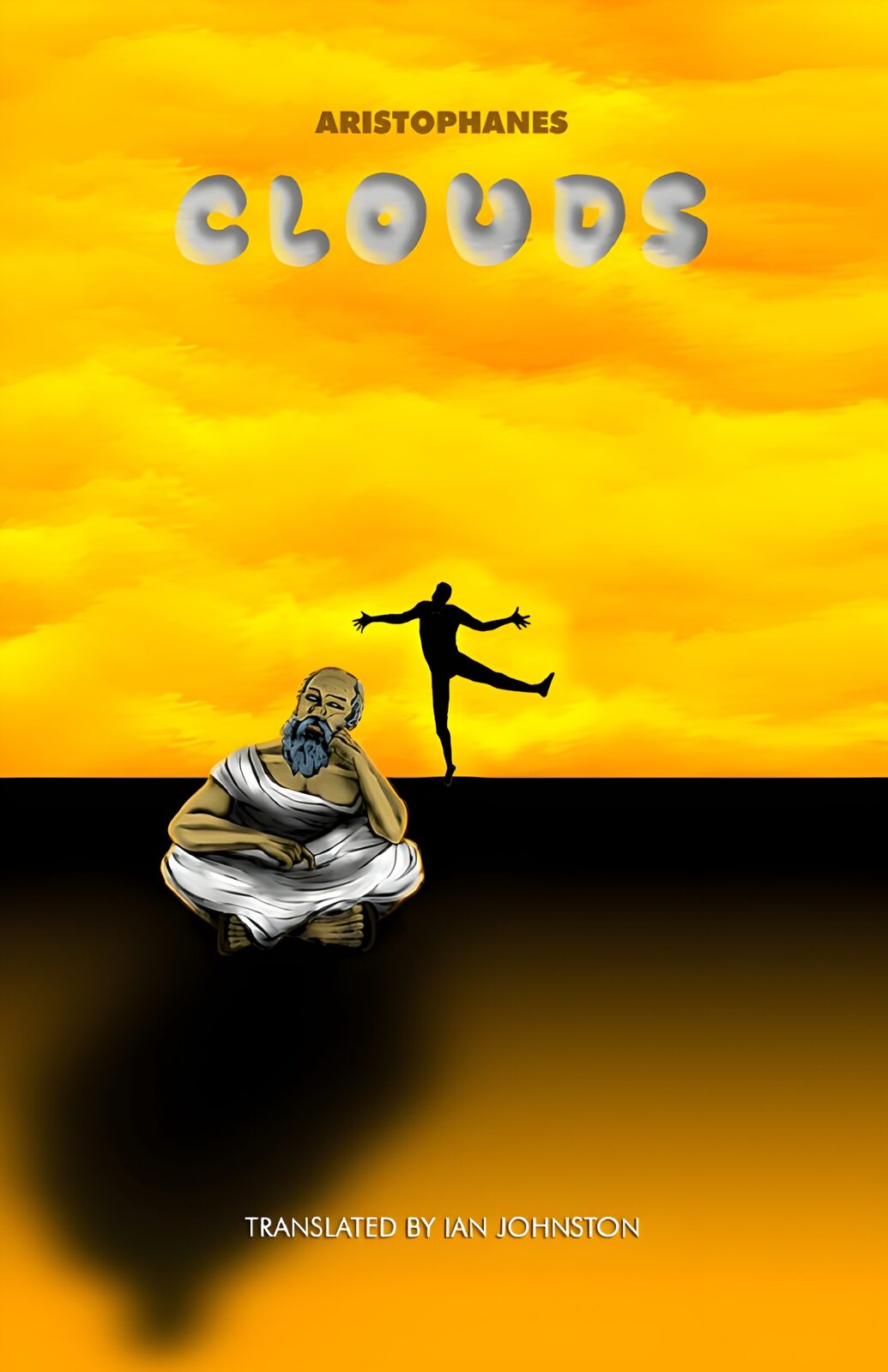
This resource may be used alongside Ian Johnston’s translation of Aristophanes’ Clouds, available from Richer Resources Publications.
A printable PDF version of this resource is available by email.