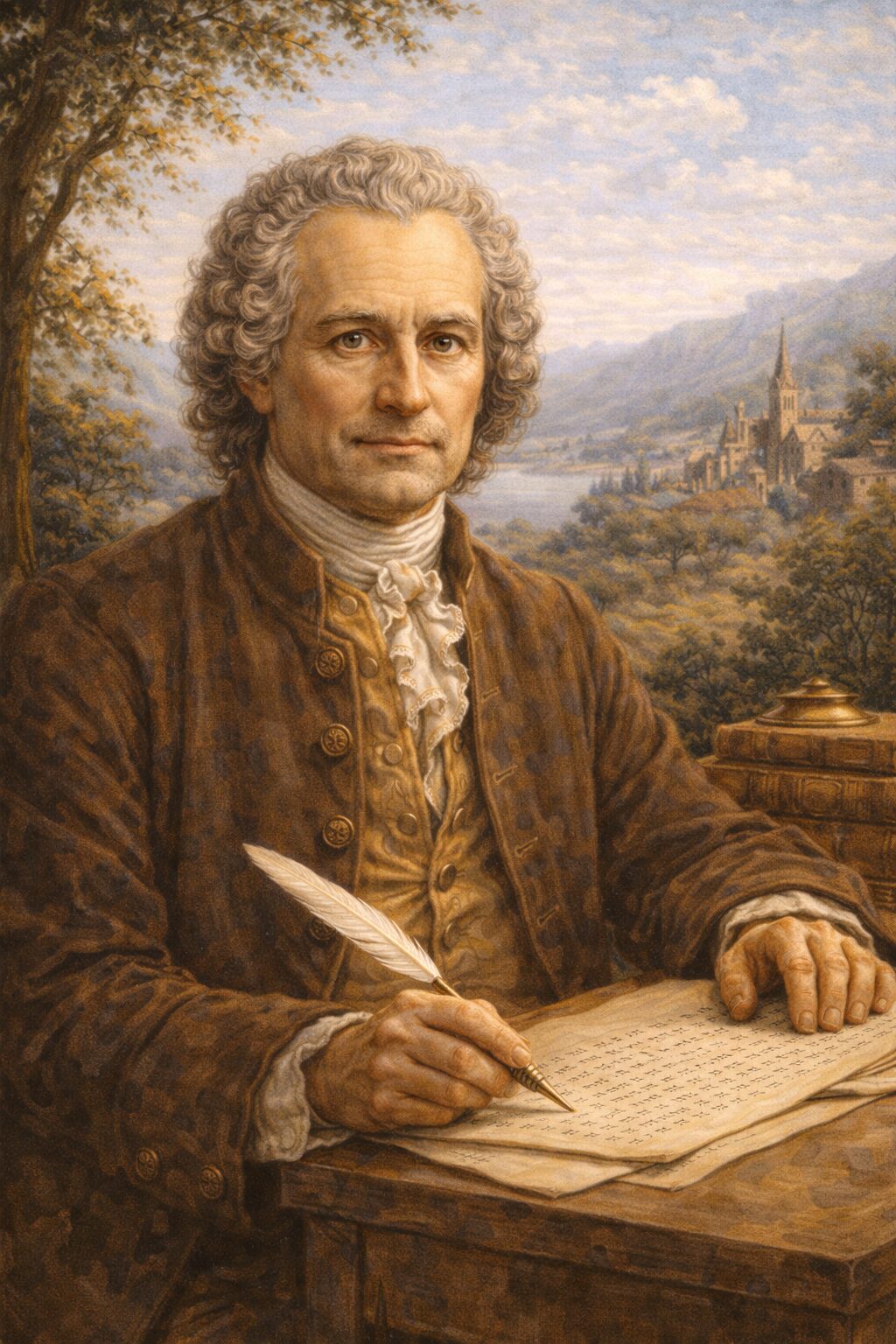
Jean-Jacques Rousseau (French: (28 June 1712 – 2 July 1778) was a Genevan philosopher, writer, and composer of the 18th century. His political philosophy influenced the French Revolution as well as the overall development of modern political, sociological, and educational thought.
Rousseau's novel Émile, or On Education is a treatise on the education of the whole person for citizenship. His sentimental novel Julie, or the New Heloise was of importance to the development of pre-romanticism[1] and romanticism in fiction. Rousseau's autobiographical writings — his Confessions, which initiated the modern autobiography, and his Reveries of a Solitary Walker — exemplified the late 18th-century movement known as the Age of Sensibility, and featured an increased focus on subjectivity and introspection that later characterized modern writing. His Discourse on the Origin of Inequality and his On the Social Contract are cornerstones in modern political and social thought. He argued that private property was conventional and the beginning of true civil society.
Rousseau was a successful composer of music, who wrote seven operas as well as music in other forms, and made contributions to music as a theorist. As a composer, his music was a blend of the late Baroque style and the emergent Classical fashion, and he belongs to the same generation of transitional composers as Christoph Willibald Gluck and C.P.E. Bach. One of his more well-known works is the one-act opera Le devin du village, containing the duet "Non, Colette n'est point trompeuse" which was later rearranged as a standalone song by Beethoven.
During the period of the French Revolution, Rousseau was the most popular of the philosophes among members of the Jacobin Club. Rousseau was interred as a national hero in the Panthéon in Paris, in 1794, 16 years after his death.