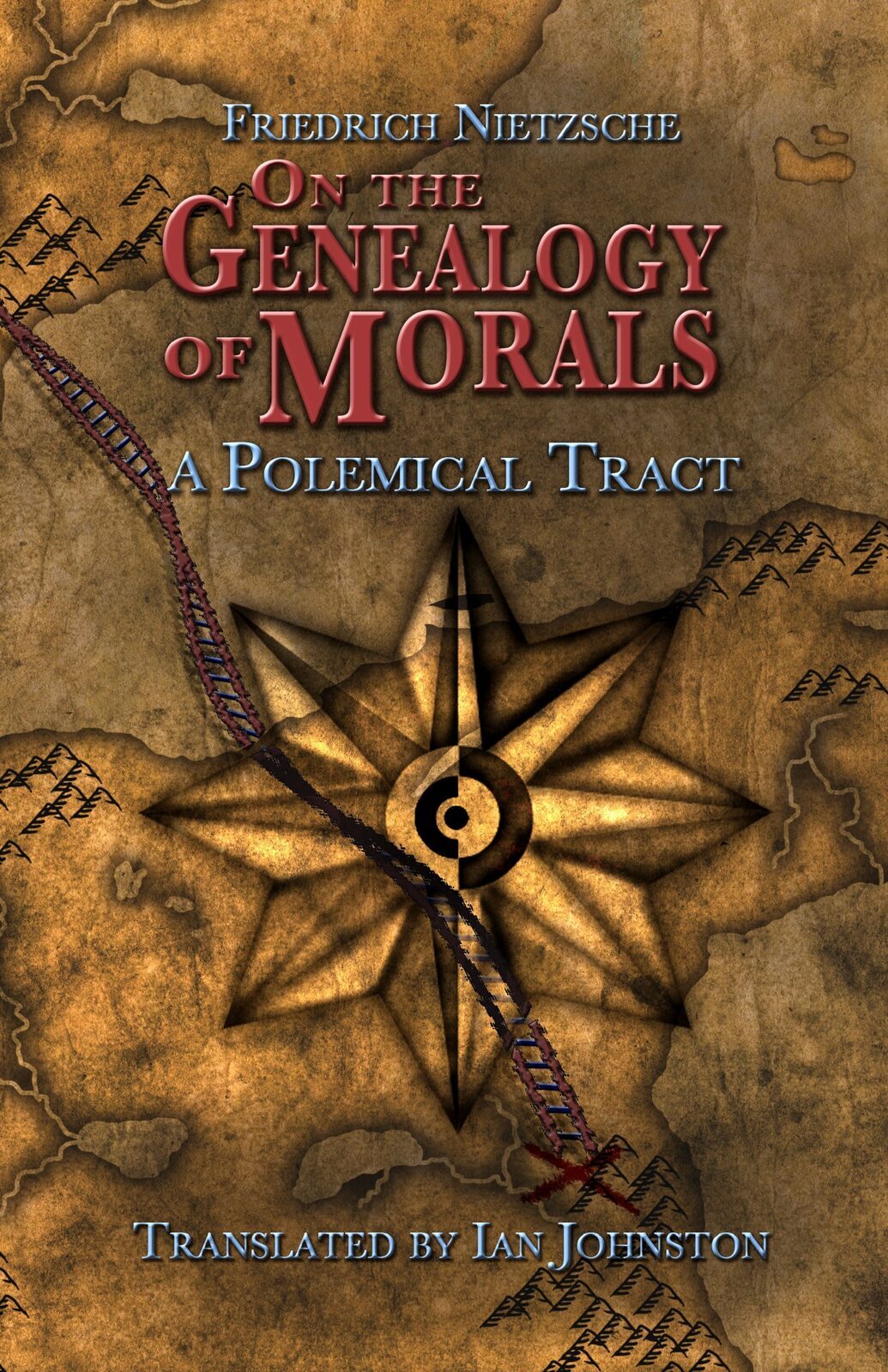
Introduction: Investigating the Origins of Morality
Published in 1887, On the Genealogy of Morals asks how familiar moral judgments arose and whether the conditions that produced them still serve human flourishing. Nietzsche offers three connected polemical essays, not a neutral history. Students should reconstruct his arguments, distinguish historical claims from psychological interpretations, and examine his evidence critically.
Historical and Intellectual Context
Nietzsche wrote this work after Beyond Good and Evil, developing his challenge to the idea that moral values are timeless and self-evident. “Genealogy” investigates how concepts acquire their meaning through conflict, custom, power, and reinterpretation. His historical reconstructions are often speculative and should not be presented as settled scholarship.
The Three Essays
First Essay — “Good and Evil,” “Good and Bad”: Nietzsche contrasts noble evaluations of “good/bad” with what he calls the slave revolt in morality, connecting ressentiment to the reversal of established values. Ask students to distinguish his proposed origins from his assessment of those values.
Second Essay — “Guilt,” “Bad Conscience,” and Related Matters: Nietzsche explores promises, punishment, debt, responsibility, and the internalization of aggressive impulses. The links between creditor–debtor relationships and moral guilt invite both philosophical and historical scrutiny.
Third Essay — What Do Ascetic Ideals Mean?: Nietzsche examines self-denial and the search for meaning, including the role of the ascetic priest. His closing concern is not merely suffering, but the human demand that suffering have a purpose.
Key Concepts
Ressentiment: A reactive, enduring hostility that Nietzsche associates with the creation of certain moral evaluations. It is not simply ordinary resentment.
Master and slave moralities: Nietzsche’s contrasting patterns of valuation, not straightforward descriptions of every historical social class or person.
Bad conscience: The turning inward of impulses that can no longer be expressed outwardly; a proposed psychological account, not a clinical diagnosis.
Ascetic ideal: A framework that assigns value to self-denial and discipline, potentially providing meaning while also restricting life.
Learning Objectives
Students should be able to:
- Summarize the central claim of each essay and explain how the three arguments connect.
- Distinguish genealogical explanation, moral evaluation, and historical evidence.
- Analyze Nietzsche’s rhetorical methods, including etymology, analogy, irony, and provocation.
- Evaluate his claims about guilt, punishment, and asceticism using reasons and counterexamples.
Suggested Four-Session Sequence
Session 1 — Method and the First Essay: Introduce genealogy and compare “good/bad” with “good/evil.” Map the proposed role of ressentiment.
Session 2 — The Second Essay: Follow Nietzsche’s account of promises, punishment, and the emergence of bad conscience. Test whether his historical inferences follow.
Session 3 — The Third Essay: Examine the ascetic priest and the relation between suffering, interpretation, and meaning.
Session 4 — Evaluation: Debate whether tracing a value’s origin can establish its worth. Compare the three essays and draft a reasoned response.
Close-Reading Suggestions
Preface §§3–6: Why does Nietzsche ask about the value of moral values? What sort of inquiry does he propose?
First Essay §§7–11: How does ressentiment enter his account of moral reversal? What is asserted, and what is demonstrated?
Second Essay §§1–6 and §§16–18: How are memory, obligation, punishment, and internalization connected?
Third Essay §§1 and §§28: What problem does the ascetic ideal answer, and at what cost?
Discussion Questions
- If a moral belief arose from hostility or fear, would that make it false or harmful? Why or why not?
- What is the difference between punishment as repayment, deterrence, reform, or revenge?
- Does Nietzsche explain guilt as a social phenomenon, a psychological experience, or both?
- Why might people prefer an explanation for suffering even if that explanation intensifies it?
- Which of Nietzsche’s historical or psychological claims is least persuasive, and what evidence would help assess it?
Classroom Activities and Assessment
Genealogy map: Students trace one moral concept through Nietzsche’s proposed stages, labeling each transition as an observation, interpretation, or speculation.
Counterargument workshop: Pairs choose one claim from an essay, write its strongest charitable reconstruction, and then develop a counterexample or alternative explanation.
Short essay: “Knowing the origin of a moral value is not the same as knowing its worth.” Evaluate this statement with examples from at least two essays.
Teaching Considerations
Nietzsche makes sweeping claims about religious traditions, social groups, and human types. Discuss these critically without treating polemical categories as objective descriptions of populations. Avoid presenting etymological suggestions or historical narratives as proven facts. Cite essay and section numbers; check quotations against Ian Johnston’s translation.
Concluding Perspective
The work invites students to examine morality as something shaped by human history and psychology rather than accepted without question. Its strongest classroom value comes from testing the method and the evidence as rigorously as its unsettling conclusions.
A printable PDF version of this resource is available by email.