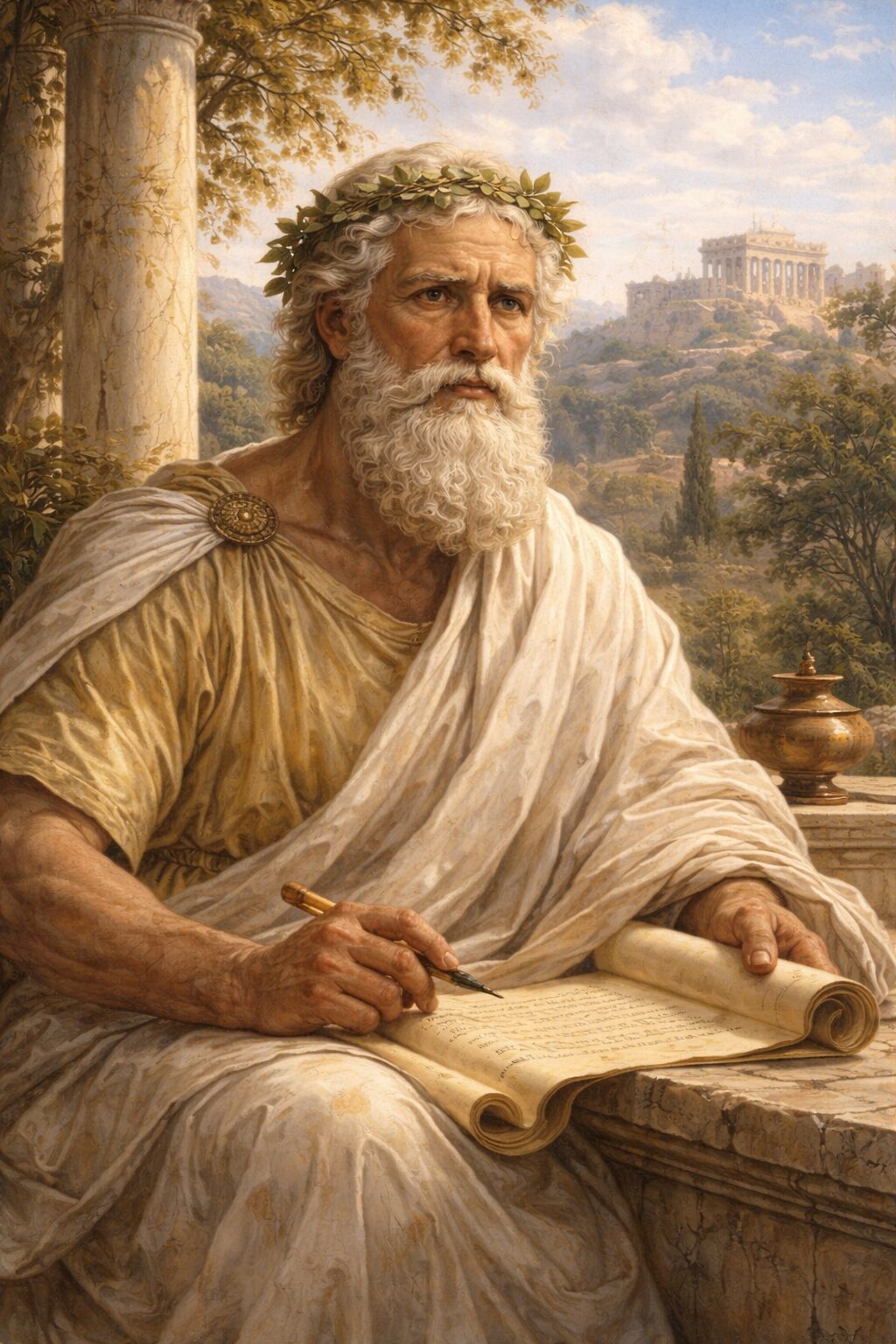
GREEK TRAGEDY • BACKGROUND GUIDE
An accessible introduction to ancient Greek tragedy, explaining its origins, major playwrights, theatrical conventions, Chorus, dramatic structure, religious context, and central conflicts. Includes essential literary terms, reading strategies, and questions students can apply to tragedies by Aeschylus, Sophocles, and Euripides.
Read resource →
ANTIGONE • QUIZ & ANSWER KEY
A classroom assessment for Sophocles’ Antigone combining reading comprehension, literary interpretation, and evidence-based short response. Includes 24 questions and a teacher answer key with explanations and guidance for evaluating interpretive responses.
Read resource →
ANTIGONE • WORKSHEET PACK
Six flexible classroom worksheets for Sophocles’ Antigone, focusing on competing obligations, decisions and consequences, listening and leadership, character analysis, turning points, and final synthesis. Designed to develop evidence-based interpretation rather than simple plot recall.
Read resource →
ANTIGONE • WRITING & ESSAY ASSIGNMENTS
A graduated collection of writing assignments for Sophocles’ Antigone, ranging from focused analytical paragraphs to literary analysis, argumentative essays, and advanced college-level prompts. Includes guidance for developing strong arguments and an optional essay-planning framework.
Read resource →
ANTIGONE • STUDENT GUIDE
A clear student guide to Sophocles’ Antigone, with essential background, character orientation, a reading roadmap, key conflicts, guidance for understanding the Chorus, questions to carry through the play, and a quick review checklist.
Read resource →
ANTIGONE • CHARACTER GUIDE
A student-friendly guide to the major characters in Sophocles’ Antigone, examining their roles, motivations, relationships, conflicts, and development throughout the tragedy. Includes a cast-at-a-glance reference, detailed character profiles, important relationships, key contrasts, and questions to guide close reading.
Read resource →
ANTIGONE • DISCUSSION QUESTIONS
A collection of open-ended discussion questions for Sophocles’ Antigone, organized around the progression of the play. Designed for close reading, whole-class conversation, small-group work, Socratic seminar, and written preparation, the questions move from Antigone’s opening decision through the final consequences of Creon’s actions.
Read resource →
ANTIGONE • VOCABULARY & GLOSSARY
A student-friendly reference to essential vocabulary for reading and discussing Sophocles’ Antigone. Covers Greek dramatic form, religious and burial practices, law and civic authority, and useful language for analyzing character and conflict, with explanations of how important terms apply to the play.
Read resource →
CRITICAL ESSAY
What makes Oedipus a tragic hero? Ian Johnston examines the tension between fate and free will in Sophocles’ Oedipus the King, arguing that the very qualities that make Oedipus great—his intelligence, courage, confidence, and relentless pursuit of truth—also lead him toward catastrophe.
Read resource →
GREEK LITERATURE & CULTURE
Ian Johnston explores how Greek ideas of justice, divine power, and human freedom shaped the heroic and tragic vision of ancient Greek literature.
Read resource →
THE WORLD OF THE ANCIENT GREEKS
A concise guide to the geography, history, political life, and cultural development of ancient Greece, from the Bronze Age civilizations of Crete and Mycenae through the rise of the city-states, Classical Athens and Sparta, and the age of Alexander the Great.
Read resource →
ANTIGONE • THEMES GUIDE
An accessible guide to six major themes in Sophocles’ Antigone: divine and human law, family and the state, authority and leadership, pride and inflexibility, gender and power, and wisdom through suffering. Includes points to watch while reading, questions for analysis, and a concluding examination of how the themes intersect.
Read resource →
SOPHOCLES—IN HIS OWN WORDS
Selected passages from Ian Johnston's Ajax Translation
Read resource →
SOPHOCLES—IN HIS OWN WORDS
Selected passages from Ian Johnston's Antigone Translation
Read resource →
SOPHOCLES—IN HIS OWN WORDS
Selected passages from Ian Johnston's Oedipus Translation
Read resource →
SOPHOCLES—IN HIS OWN WORDS
Selected passages from Ian Johnston's Oedipus at Colonus Translation
Read resource →
SOPHOCLES—IN HIS OWN WORDS
Selected passages from Ian Johnston's Philoctetes Translation
Read resource →
SOPHOCLES—IN HIS OWN WORDS
Selected passages from Ian Johnston's Women of Trachis, Translation
Read resource →
GREEK TRAGEDY • BACKGROUND GUIDE
A clear introduction to the structure of ancient Greek tragedy, explaining the prologue, parodos, episodes, stasima, and exodos. Includes additional dramatic terms, a simplified performance sequence, an example from Sophocles’ Antigone, close-reading questions, and a classroom exercise.
Read resource →
ANTIGONE • TEACHER GUIDE
A practical guide to teaching Sophocles’ Antigone, with essential background, character guidance, dramatic structure, central themes, close-reading scenes, a flexible seven-class sequence, discussion questions, writing assignments, and guidance for teaching the tragic ending.
Read resource →
GREEK TRAGEDY • BACKGROUND GUIDE
An accessible guide to the Chorus in ancient Greek tragedy, explaining its role as a collective voice, dramatic participant, and performer of choral odes. Includes examples from Antigone, Oedipus the King, and Medea, along with reading strategies, discussion questions, and a classroom activity.
Read resource →
GREEK TRAGEDY
Sophocles turns a murder investigation into something far more unsettling: a search for the truth about the investigator himself.
Read resource →
GREEK TRAGEDY • THEATER & PERFORMANCE
A student-friendly introduction to the ancient Greek theater and the performance traditions of tragedy. Explains the theatron, orchestra, skene, actors, masks, costumes, the Chorus, music, messenger speeches, and festival audiences, with practical questions to help students imagine how Greek tragedies were originally experienced
Read resource →
BOOK TRAILER
A visual introduction to Sophocles’ Ajax, a Greek tragedy exploring honor, rage, identity, and the psychological cost of war.
Read resource →
BOOK TRAILER
A visual introduction to Sophocles’ Antigone and its enduring conflict between moral law, civil authority, and individual conscience.
Read resource →
BOOK TRAILER
A visual introduction to Sophocles’ Oedipus the King, a Greek tragedy about fate, knowledge, responsibility, and a ruler’s search for truth.
Read resource →
BOOK TRAILER
A visual introduction to Sophocles' Philoctetes, a Greek tragedy exploring isolation, suffering, persuasion, honor, and moral responsibility.
Read resource →